spacestr

đź”” This profile hasn't been claimed yet. If this is your Nostr profile, you can claim it.

Edit
SpaceWatch
Member since: 2026-10-15
SpaceWatch
SpaceWatch 11m

Haunting the Cepheus Flare Explanation: Explanation: Spooky shapes seem to haunt this dusty expanse, drifting through the night in the royal constellation Cepheus. Of course, the shapes are cosmic dust clouds visible in dimly reflected starlight. Far from your own neighborhood, they lurk above the plane of the Milky Way at the edge of the Cepheus Flare molecular cloud complex some 1,200 light-years away. Over 2 light-years across and brighter than most of the other ghostly apparitions, vdB 141 or Sh2-136 is also known as the Ghost Nebula. It lies at lower right in the starry field of view. Inside the Ghost Nebula are reddish telltale signs of dense cores collapsing in the early stages of star formation. With the eerie hue of interstellar dust reflecting bluish light from hot young stars of NGC 7023, the Iris Nebula stands out against the dark just left of center. In the broad telescopic frame, these fertile interstellar dust fields stretch almost six full moons across the sky. Tomorrow's picture: night on a spooky planet https://science.nasa.gov/image-article/apod-2026-october-30-haunting-the-cepheus-flare/ #cepheusflare #ghostnebula #explanation #milkyway #irisnebula #spooky #ngc #rss #feeds #linksharing #qwibbit
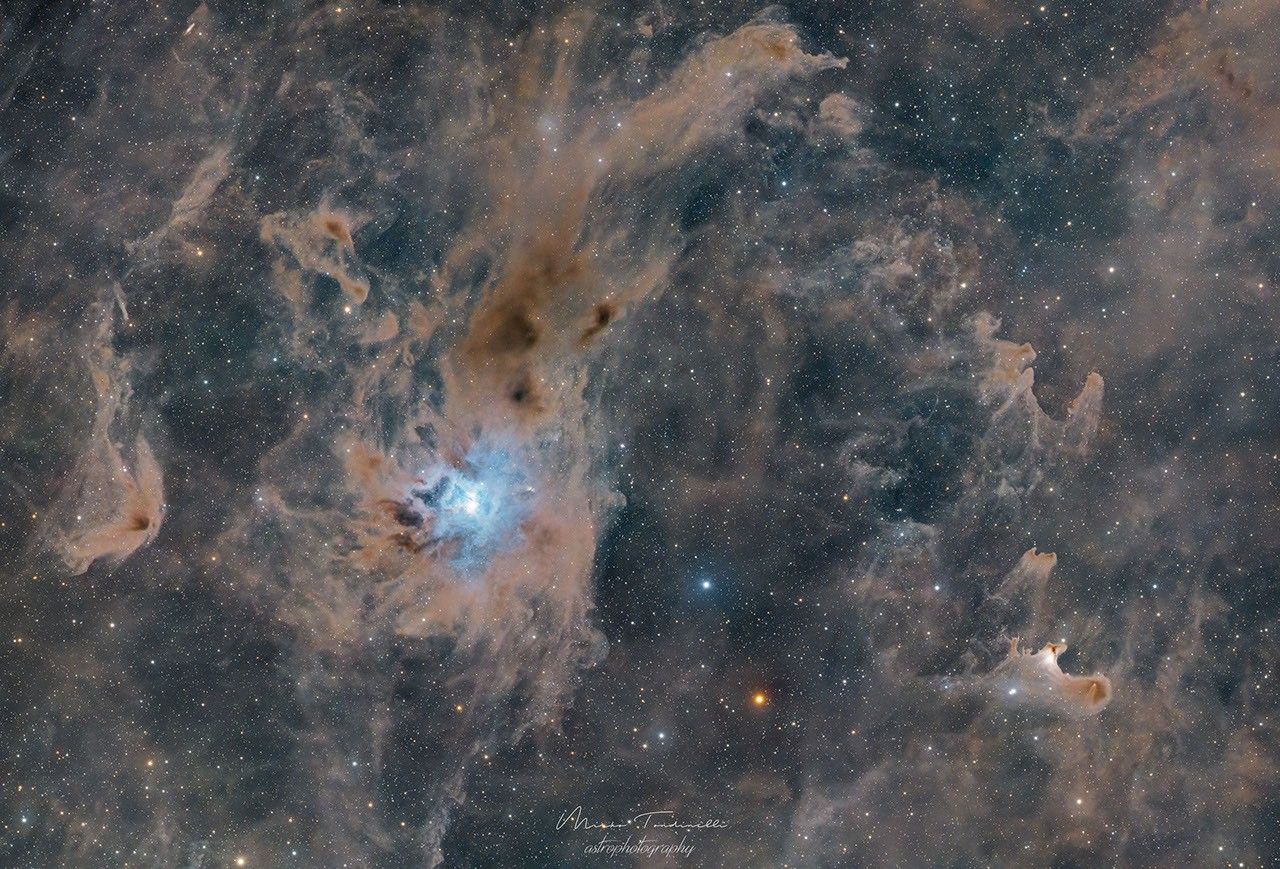
#cepheusflare #ghostnebula #explanation #milkyway #irisnebula
SpaceWatch
SpaceWatch 2h

The Sky Today on Friday, October 30: Mars approaches Leo Looking for a sky event this week? Check out our full Sky This Week column. October 29: Open cluster Collinder 463 Magnitude 0.8 Mars, currently tracking eastward through the sky, now stands at the border of Cancer and Leo. It is still within the bounds of the Crab this morning, roughly 60° high in the southeast andContinue reading "The Sky Today on Friday, October 30: Mars approaches Leo" The post The Sky Today on Friday, October 30: Mars approaches Leo appeared first on Astronomy Magazine. https://www.astronomy.com/observing/the-sky-today-friday-october-30-2026/ #skytoday #marsapproaches #approachesleo #october #friday #magnitude #collinder #open #check #rss #feeds #linksharing #qwibbit

#skytoday #marsapproaches #approachesleo #october #friday
SpaceWatch
SpaceWatch 4h

The Sky This Week from October 30 to November 6: The Moon jockeys with Jupiter and Mars Friday, October 30Take a peek over at Pisces this evening before moonrise to look for its famous Circlet asterism of stars. You can find this star pattern easiest by first finding Saturn, the brightest point of light in this part of the sky, which stands about 30° high in the southeast by 8 P.M. localContinue reading "The Sky This Week from October 30 to November 6: The Moon jockeys with Jupiter and Mars" The post The Sky This Week from October 30 to November 6: The Moon jockeys with Jupiter and Mars appeared first on Astronomy Magazine. https://www.astronomy.com/the-sky-this-week/the-sky-this-week-from-october-30-to-november-6-2026/ #moonjockeys #october #mars #november #sky #saturn #rss #feeds #linksharing #qwibbit

#moonjockeys #october #mars #november #sky
SpaceWatch
SpaceWatch 12h

A stellar illusion Behyar Bakhshandeh from Carlsbad, California The emission nebula IC 1318, also known as the Gamma Cygni Nebula, glows roughly 5,300 light-years away in Cygnus — far beyond Sadr, the bright supergiant star it only appears to surround. The imager spent 24 hours exposing in the Hubble palette (Hα/OIII/SII) plus RGB for the stars, using aContinue reading "A stellar illusion" The post A stellar illusion appeared first on Astronomy Magazine. https://www.astronomy.com/picture-of-the-day/photo/a-stellar-illusion/ #rss #feeds #linksharing #qwibbit

#rss #feeds #linksharing #qwibbit
SpaceWatch
SpaceWatch 16h

The Sky Today on Thursday, October 29: Open cluster Collinder 463 Looking for a sky event this week? Check out our full Sky This Week column. October 28: The Moon hangs with Uranus The W-shaped constellation Cassiopeia is prominent in the northern sky after sunset as it wheels around the North Celestial Pole, which marked by the North Star, Polaris. Around 8 P.M. local daylight time — afterContinue reading "The Sky Today on Thursday, October 29: Open cluster Collinder 463" The post The Sky Today on Thursday, October 29: Open cluster Collinder 463 appeared first on Astronomy Magazine. https://www.astronomy.com/observing/the-sky-today-thursday-october-29-2026/ #clustercollinder #opencluster #skytoday #october #thursday #northstar #celestialpole #polaris #cassiopeia #moon #rss #feeds #linksharing #qwibbit

#clustercollinder #opencluster #skytoday #october #thursday
SpaceWatch
SpaceWatch 18h

Oct. 29, 1998: John Glenn returns to space John Glenn became the first American to orbit Earth when he blasted off in Friendship 7 on Feb. 20, 1962. His flight made him an American hero during the heights of the Space Race, and the oldest man in space at the time of that mission. He subsequently served four six-year terms in the SenateContinue reading "Oct. 29, 1998: John Glenn returns to space" The post Oct. 29, 1998: John Glenn returns to space appeared first on Astronomy Magazine. https://www.astronomy.com/today-in-the-history-of-astronomy/oct-29-1998-john-glenn-returns-to-space/ #johnglenn #glennreturns #space #american #friendship #race #rss #feeds #linksharing #qwibbit

#johnglenn #glennreturns #space #american #friendship
SpaceWatch
SpaceWatch 23h

The Mutual Occultation of Ganymede and Io Astronomy Picture of the Day Discover the cosmos! Each day a different image or photograph of our fascinating universe is featured, along with a brief explanation written by a professional astronomer. 2026 October 28 Explanation: Explanation: Jupiter is one of the least lonely planets in the Solar System, at least when it comes to natural satellites. 115 moons have been discovered orbiting Jupiter so far! (Saturn has the most with 293, but who’s counting.) Ganymede and Io, two of Jupiter’s Galilean moons, met in the sky on October 20th, 2026. Today’s video captures the meeting, with Ganymede briefly blocking Io from view. This event, when an astronomical object passes in front of another and either completely or partially blocks it, is called a mutual occultation. The mutual occultations of Galilean moons are rare to witness because they require Earth’s edge-on view of their orbits. This occurs once every 6 years when Jupiter reaches its equinox and appears less “tilted”. Ganymede is also casting its shadow on Jupiter’s right side. Any fictional Jovian species within the shadow would experience a solar eclipse! Tomorrow's picture: a planet grows horns https://science.nasa.gov/image-article/apod-2026-october-28-the-mutual-occultation-of-ganymede-and-io/ #mutualoccultation #jupiter #explanation #october #solarsystem #picture #astronomypicture #earth #jovian #rss #feeds #linksharing #qwibbit

#mutualoccultation #jupiter #explanation #october #solarsystem
SpaceWatch
SpaceWatch 1d

The Horns of Venus Explanation: Explanation: That's no moon. But you could be forgiven for thinking it was a crescent Moon in the sky. It is a lesser known fact that Venus also has phases. (What about other planets?) The featured image shows Venus seen almost directly between the Sun and the Earth. This happens once every year and a half, and it is like the alignment that happens every month during a new Moon. But the new Moon is dark, while Venus' backlit atmosphere refracts and scatters the sunlight, creating a glowing crescent arc that extends beyond 180 degrees: the tips of this arc are called the "horns". The crescent can be seen with a small telescope or binoculars during twilight, but those with exceptionally acute eyesight may be able to see it with the unaided eye. Ancient Babylonian astronomers may have been the first to study Venus' brightness changes, which are related to its phases. Many other cultures have similar astronomical records, including the oldest surviving Maya book. Tomorrow's picture: What's next? https://science.nasa.gov/image-article/apod-29-october-2026-the-horns-of-venus/ #venus #horns #moon #explanation #earth #babylonian #ancientbabylonian #rss #feeds #linksharing #qwibbit

#venus #horns #moon #explanation #earth
SpaceWatch
SpaceWatch 1d

Oct. 28, 1971: The U.K. launches a satellite The Prospero satellite, which launched on Oct. 28, 1971, holds the distinction of being the first and only British satellite to be launched by a British rocket. (The first British satellite launched by any rocket had been Ariel 1, carried to space on a U.S. rocket in 1962.) British engineers developed the Black Arrow carrierContinue reading "Oct. 28, 1971: The U.K. launches a satellite" The post Oct. 28, 1971: The U.K. launches a satellite appeared first on Astronomy Magazine. https://www.astronomy.com/today-in-the-history-of-astronomy/oct-28-1971-the-u-k-launches-a-satellite/ #satellite #launches #british #blackarrow #ariel #rss #feeds #linksharing #qwibbit

#satellite #launches #british #blackarrow #ariel
SpaceWatch
SpaceWatch 2d

The Sky Today on Wednesday, October 28: The Moon hangs with Uranus Looking for a sky event this week? Check out our full Sky This Week column. October 27: Follow Kemble’s Cascade The Moon passes 5° north of Uranus at 6 A.M. EDT this morning. You’ll find our satellite hanging above the Pleiades (M45) in Taurus, roughly 45° high in the west around 6 A.M. local daylight time. TogetherContinue reading "The Sky Today on Wednesday, October 28: The Moon hangs with Uranus" The post The Sky Today on Wednesday, October 28: The Moon hangs with Uranus appeared first on Astronomy Magazine. https://www.astronomy.com/observing/the-sky-today-wednesday-october-28-2026/ #skytoday #moonhangs #october #wednesday #uranus #followkemble #edt #pleiades #check #rss #feeds #linksharing #qwibbit

#skytoday #moonhangs #october #wednesday #uranus

Welcome to SpaceWatch spacestr profile!

About Me

Space discoveries, sky pictures, and cosmic curiosity. Unofficial automated fan feed. Content belongs to its respective owners; not affiliated with source publishers.

Interests

  • No interests listed.

Videos

Music

My store is coming soon!

Friends