Reading List 10/24/26
The Great Day of His Wrath, by John Martin, via WikiArt.
Welcome to the reading list, a weekly roundup of news and links related to buildings, infrastructure and industrial technology. This week we look at minimum lot sizes, Boeing’s next 737 MAX, Fervo short sellers, Figure AI’s training data, and more. Roughly 2/3rds of the reading list is paywalled, so for full access become a paid subscriber.
No essay this week, but I’m working on a piece about manufacturing isotopes that should be out next week.
Housing and Cities
Almost two thirds of US homebuilders said immigration enforcement is affecting their labor force, up from 23% in March and 13% a year ago. [WSJ]
I had always heard of “minimum lot sizes” as one of the many land-use regulations that restricts the supply of new housing, but I had no idea how extensive they were. But a new report from AEI claims that 90% of jurisdictions have some sort of minimum lot size, and that this is a major barrier to constructing smaller, less expensive starter homes. [AEI]
Canadian real house prices have more than doubled since 2005. [CMHC]
Airbnb bans making guests do the dishes and take out the trash. [The Verge]
The Wall Street Journal on rising pedestrian deaths on US roads. It places the blame chiefly on road design, though it doesn’t explain why road design would cause a sudden uptick around 2009. [WSJ] See also my previous essays about US pedestrian deaths.
The market share of modular and panelized housing construction in the US remains very low. “The total market share of non-site-built single-family homes (modular and panelized) was just 3% of single-family homes in 2025, according to NAHB analysis of completion data from the U.S. Census Bureau’s Survey of Construction (SOC). This matched the 3% market share recorded in both 2023 and 2024.” [NAHB]
Manufacturing
The FAA certifies another version of Boeing’s 737 MAX, the 737-10. Boeing currently has 1555 orders for it. [Boeing]
Worries about the shipbuilding gap between the US and China often focus on commercial ship output (of which the US has virtually none), but it seems that there’s also a substantial gap in naval vessel output. “The combined tonnage of combat ships built by China in the two years through to December 2025 amounted to 636,208 tons, compared to 270,509 tons for the United States, according to data compiled by Flottes de Combat and French maritime industry association Gican.” [Defense News]
Former Tesla executive Drew Baglino’s solid-state transformer startup, Heron Power, signs an agreement for 1 GW worth of manufacturing capacity for data center developer Vantage. [Heron Power]
Is optical fiber going to be the next data center-induced shortage? “Tightening supply is projected to push spot prices for finished optical fiber products to 2.8–5 times their 2025 levels or higher. In response, telecom operators are shifting from short-term purchasing to long-term supply agreements (LTAs) to lock in fiber supply early.” [TrendForce]
Helium has been re-added to the US’s list of critical materials. A good time to revisit my piece on why helium is hard to replace. [X]
Seems bad. “[T]he U.S. aluminum industry, the world’s leading supplier just 25 years ago, produces a mere 1% of global output today. Moreover, there are zero operating smelters in the United States—or in a NATO country—capable of producing the high-purity aluminum required for military applications; the only comparable sources—China, Russia, and the United Arab Emirates—are highly precarious.“ [American Primary Aluminum Association]
Former OpenAI research chief Bob McGrew’s manufacturing startup Arda, which is doing manufacturing automation, raises $160 million. ““When a design changes, you can retrain a human in a day — but it takes three to six months in order to change the automation to reflect the new design,” McGrew said. “We’ve built a software and AI product that basically allows manufacturing engineers to build assembly lines much faster.”” [CNBC]
Read more
https://www.construction-physics.com/p/reading-list-102426
#readinglist #johnmartin #greatday #heronpower #boeing #max #wsj #manufacturing #housing #aei
#rss #feeds #linksharing #qwibbit
Reading List 10/17/26
La Conquete, by Jose Clemente Orozco, via WikiArt.
Welcome to the reading list, a weekly roundup of news and links related to buildings, infrastructure, and industrial technology. This week we look at Icon’s fundraising, employment in China’s solar industry, grid-scale battery reliability, Tesla’s flying roadster, and more. Roughly 2/3rds of the reading list is paywalled, so for full access become a paid subscriber.
Housekeeping items this week:
I was on MTS Live talking about robots, prefabricated construction, and other things.
I’m quoted in this Dispatch article about data center construction.
Housing and Cities
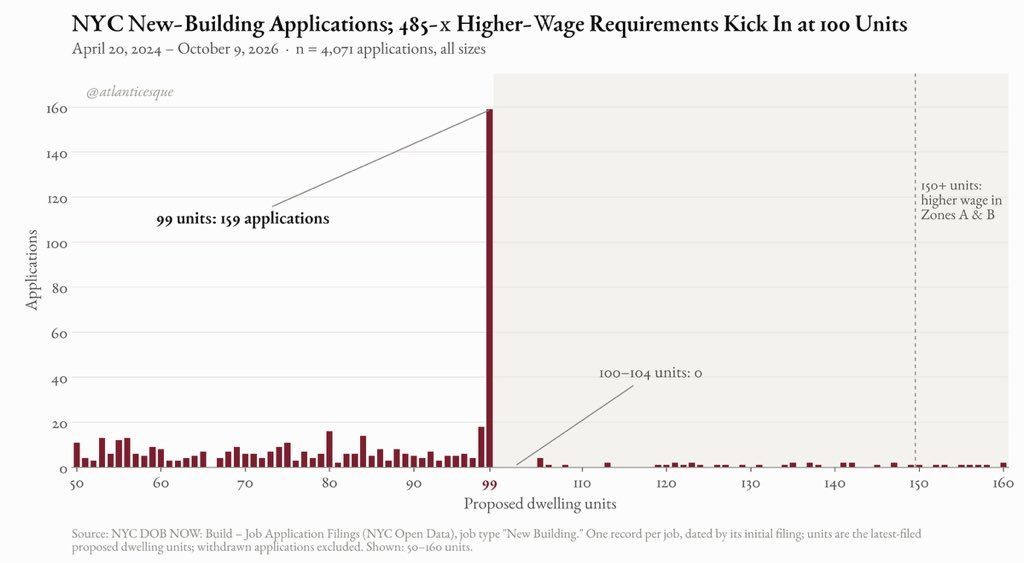
From the annals of “suspicious discontinuities,” New York City has a tax break for new projects that set aside some proportion of the units as affordable housing called “485-x.” If a project has more than 99 units, the required share of units that are “affordable” goes up, and so do the wages that need to be paid for construction workers, resulting in a very large number of projects that are exactly 99 units. [X] [Housing Wire]
DR Horton, the largest homebuilder in the US, signed an agreement to access the services of Canadian construction automation startup Promise Robotics for more than 1250 homes. Promise seems to offer some sort of AI-driven, robotic factory-based construction service. “Promise Robotics applies AI across the homebuilding production process by interpreting existing home designs, generating production plans and robotic instructions, orchestrating manufacturing, and connecting that production with site installation.” [Promise Robotics] One possible future I see for construction automation is “AI + robotics changes the logic of prefab construction and makes it more attractive,” so it’ll be interesting to see if things like this play out.
Also in construction automation news, construction 3D printing startup Icon raises a $200 million series D, at a $1.4 billion valuation. [Dealroom] This is surprising to me: I had sort of assumed things weren’t going well for the company. Though this does seem to be a “down round” — in 2022 its valuation was supposedly “approaching $ 2 billion” — I’m nevertheless adjusting my probabilities of success for Icon upward somewhat.
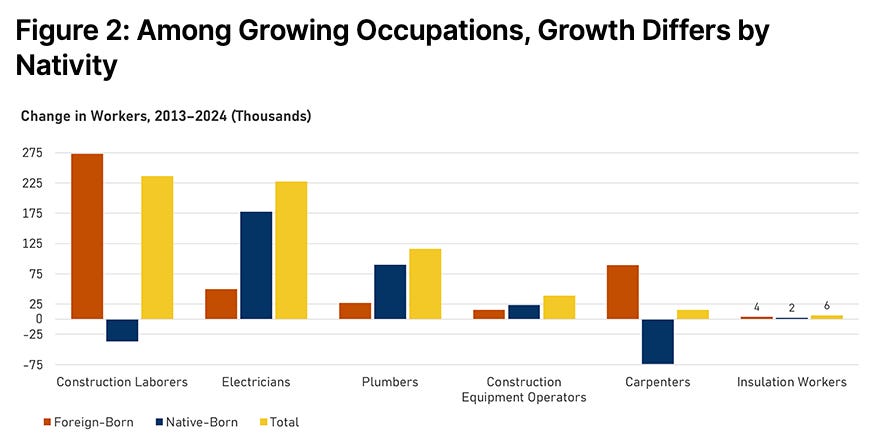
Some interesting data from Harvard’s Joint Center for Housing Studies on immigrants in the US construction industry. One stat I found notable: between 2013 and 2024, the number of foreign-born workers who were construction laborers or carpenters increased massively, even as the number of native-born workers in those occupations declined. But for electricians and plumbers (licensed professions), most of the increase came from native-born workers. [Harvard JCHS]
Manufacturing
GlobalFoundries, the semiconductor manufacturer that was spun off from AMD in 2009, will operate two new fabs planned for New York, funded by $21 billion from Japan. The US government is also taking a 4% equity stake in the company. [GlobalFoundries]
ASML says it can’t currently meet customer demand for lithography machines for 2027 and 2028, and is looking for ways to increase capacity. [ASML]
Ruthless competition in China’s solar industry: employment at China’s five biggest solar manufacturers fell 21% last year, and 31% the year before. [Reuters]
The US isn’t the only country with a small number of companies that make the grain-oriented electrical steel (GOES) needed for power transformers. Only two EU companies, Thyssenkrupp and Stalprodukt, make it, and as in the US they can’t make the highest quality steel. “The global leaders—the companies that make the world’s best GOES—by and large are in [South] Korea and Japan,” Alimento says. “In the U.S. and in the EU, domestic manufacturers are not capable of making that quality of GOES, because it is a heavily protected trade secret.” [IEEE Spectrum]
Thanks to ongoing memory shortages as a result of AI data center construction, smartphone shipments are down 20% year over year. [Counterpoint]
Read more
https://www.construction-physics.com/p/reading-list-101726
#readinglist #promiserobotics #clementeorozco #joseclemente #newyork #housing #icon #harvard #center #manufacturing
#rss #feeds #linksharing #qwibbit
Reading List 10/10/26
The Miraculous Draft of Fishes, by Konrad Witz, via Wikipedia.
Welcome to the reading list, a weekly roundup of news and links related to buildings, infrastructure, and industrial technology. This week we look at propane in air conditioners, Anduril making submarine parts, nuclear reactors on the moon, the robotic hand landscape (handscape?), and more. Roughly 2/3rds of the reading list is paywalled, so for full access become a paid subscriber.
Housing
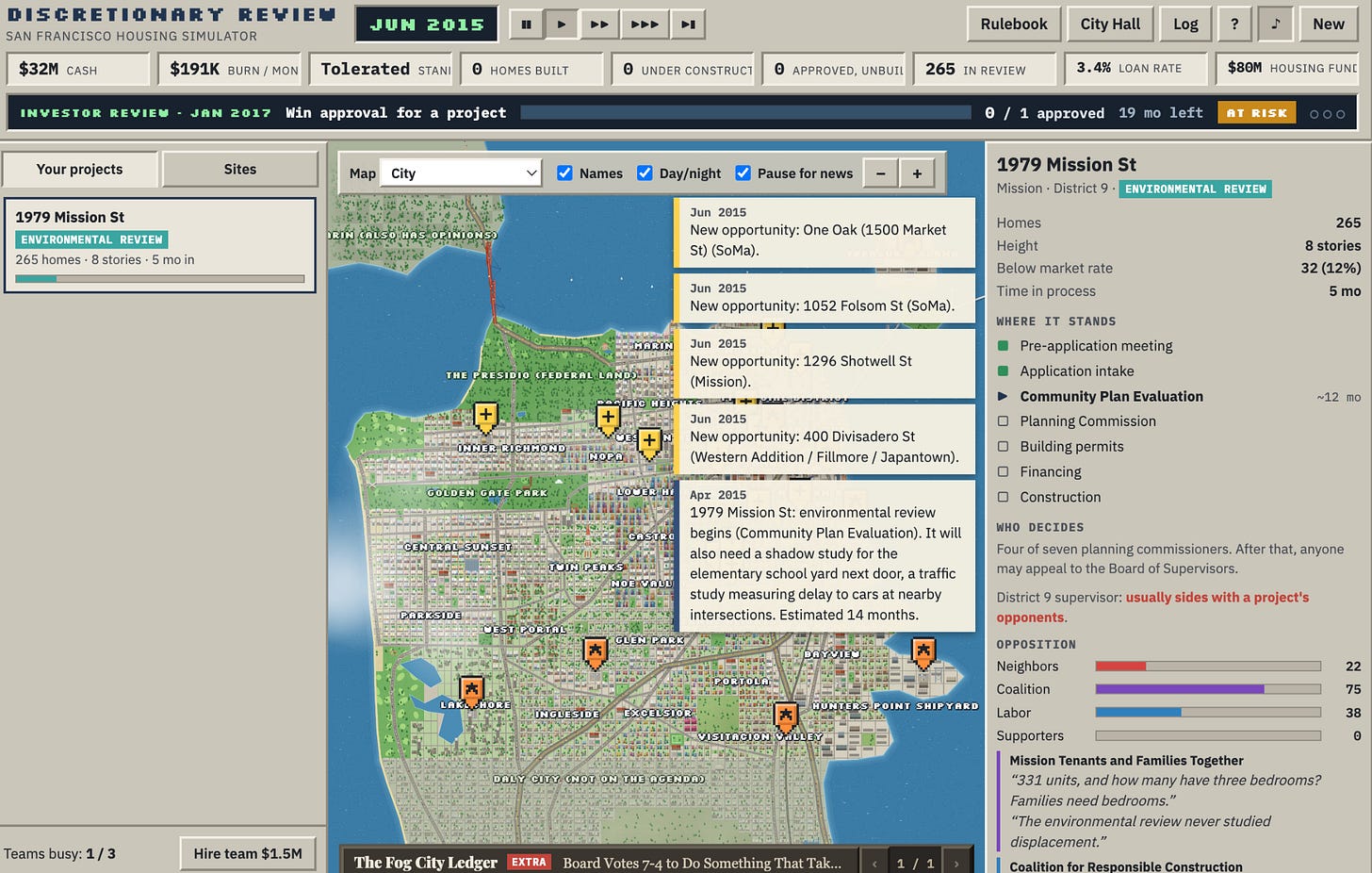
Someone created a city building game where you try to navigate local opposition to get housing built in San Francisco. [X]
I somehow missed this paper from last year analyzing the impact of International Building Code changes from 2012 to 2021 on construction costs. “Between 2012 and 2021, the International Code Council (ICC) adopted 130 revisions to the International Building Code (IBC) affecting multifamily development. Using a detailed prototype of a three-story apartment building and holding material prices and labor productivity constant at 2024 levels, we find that 16 of these revisions raised national average construction costs by 9.9 percent relative to a 2009 IBC baseline, with fire protection requirements accounting for the largest share.” [SSRN]
Should we be using propane as a refrigerant in our heat pumps and air conditioners? [The Rebuild]
Another look at what’s in the Senate’s new permitting reform bill. [Abundance and Growth]
Manufacturing
Atomic Machines, a manufacturing startup using a vaguely described manufacturing process that “builds working micro machines from code alone” (whatever that means) emerged from stealth and got a lot of attention on Twitter. [X] A NYT article on the company has a little more information, but not much. “Using the same techniques that drive a chatbot, Atomic Machines is building A.I. technology that can discover new ways of designing extremely small devices. By analyzing thousands of experiments involving standard manufacturing materials and finding patterns in how these materials interact, it learns to piece them together in ways that produce viable devices.” [NYT]
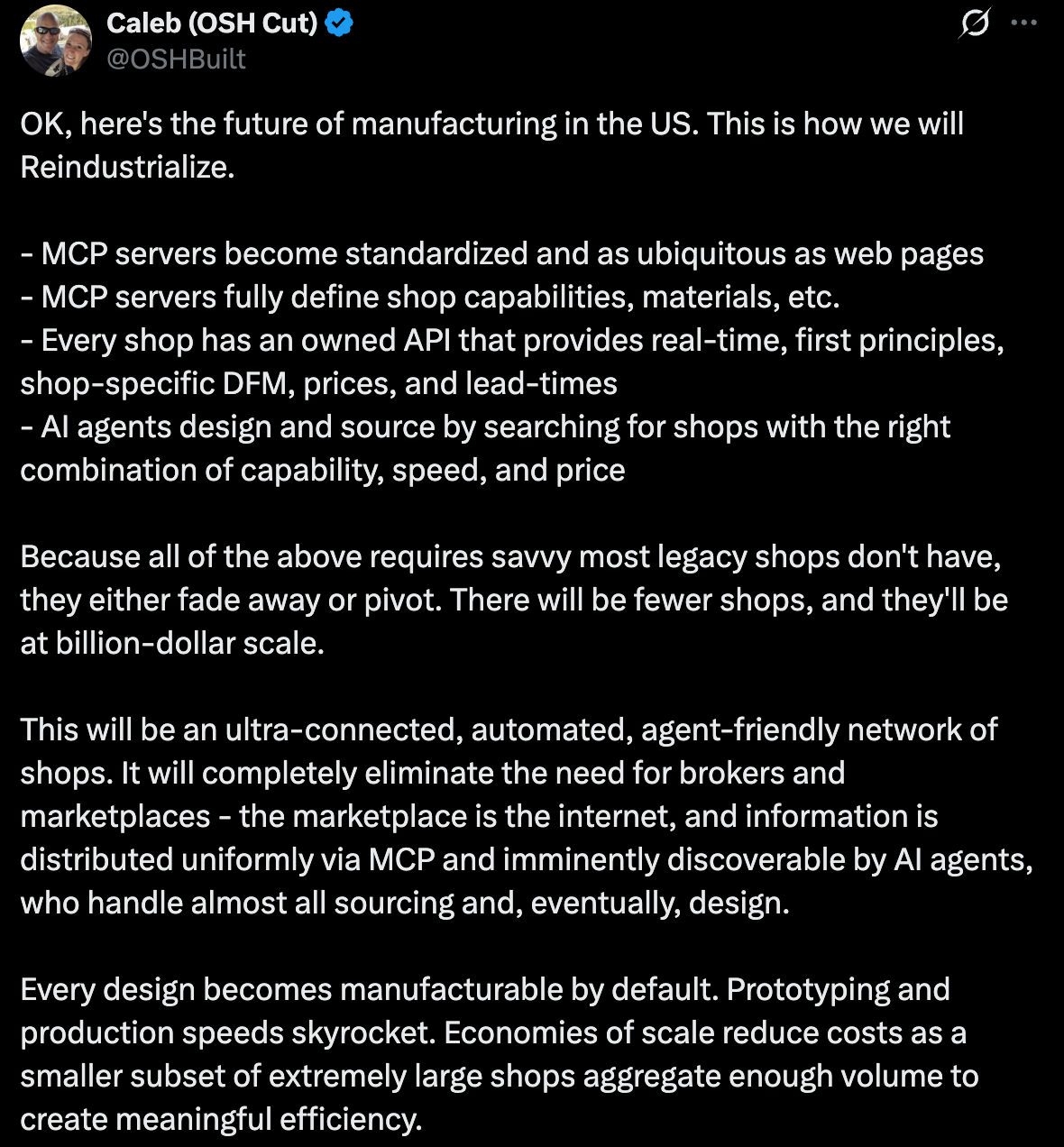
The CEO of OSH Cut (a similar sort of business to SentCutSend) on what he thinks the future of manufacturing looks like. A few similarities here to my concept of “AWS for Everything.” [X]
The Navy awarded defense startup Anduril a $2.9 billion contract to manufacture components for Virginia-class nuclear submarines. “Arsenal-2 will build complex components and large scale assemblies of the Virginia-class submarine and deliver them to Electric Boat and Newport News Shipbuilding for final assembly. Adding another source of this work will allow more submarine construction to happen in parallel across the industrial base and increase the overall capacity available to the Virginia-class program.” [Anduril]
Domestic car sales in China have apparently not risen at all since roughly 2015? [X]
Related, Chinese car sales are really taking off in Britain. “The Jaecoo 7, made by China’s Chery Automobile, was Britain’s bestselling vehicle in September, an important sales month in the U.K. In the first half of 2026, almost every sixth car sold in Britain bore a Chinese brand, according to Schmidt Automotive Research, a higher proportion than in any other European country except Norway.” [WSJ]
Read more
https://www.construction-physics.com/p/reading-list-101026
Brian Potter (Unofficial)14d
How to Train Your Robot
The enormous advance in AI capabilities over the last several years has in large part been driven by the availability of vast amounts of training data. Gwern’s influential 2020 essay “The Scaling Hypothesis,” written after the release of GPT-3, argues that recent advances in AI have been the result of scale: bigger models, bigger datasets, and more compute spent training them. Gwern writes:
The scaling hypothesis regards the blessings of scale as the secret of AGI: intelligence is ‘just’ simple neural units & learning algorithms applied to diverse experiences at a (currently) unreachable scale. As increasing computational resources permit running such algorithms at the necessary scale, the neural networks will get ever more intelligent.
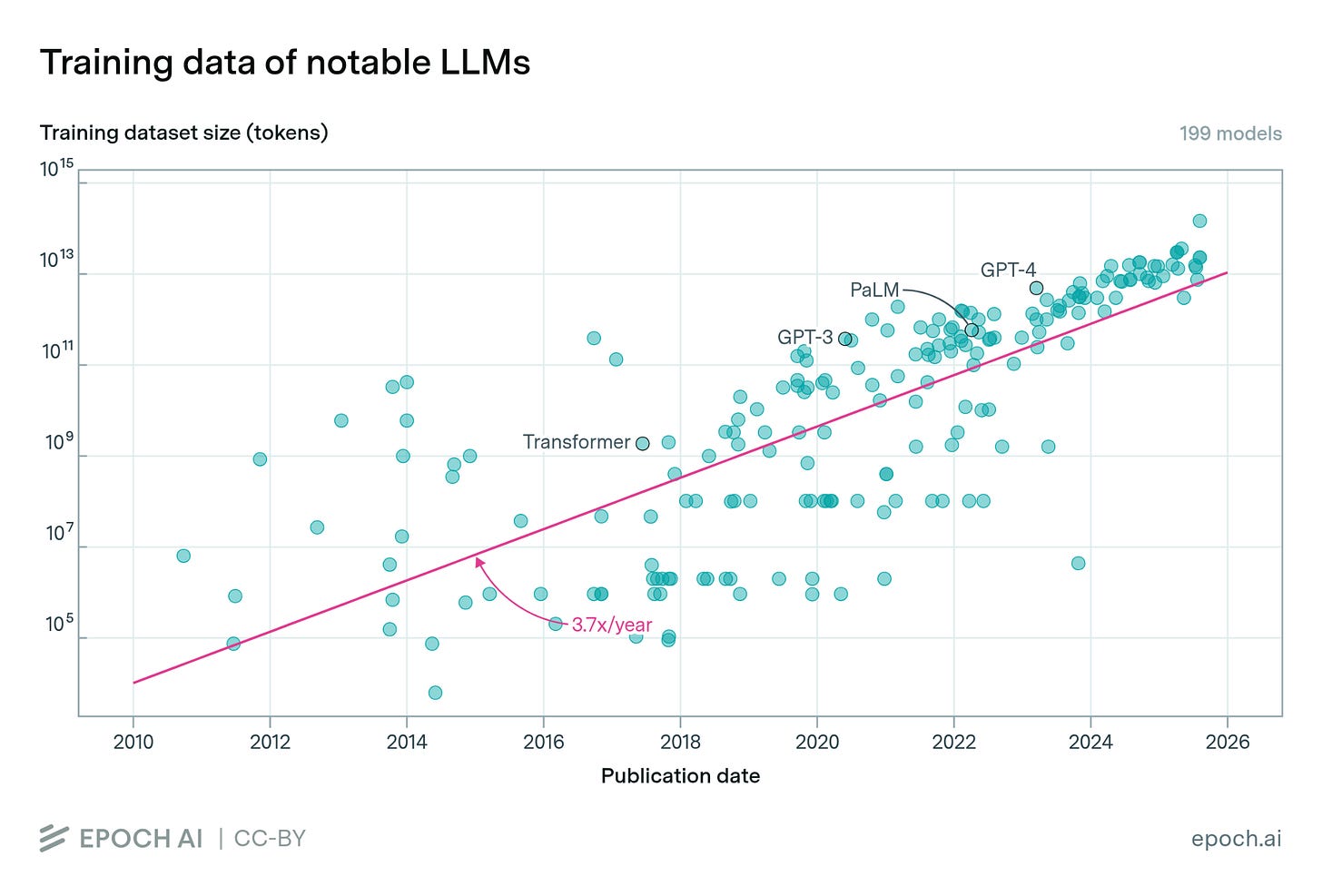
Likewise, pseudonymous AI researcher Nostalgebraist wrote in 2024 that “the entire current landscape dates back to the realization that ML models improve steadily and predictably as you train them on more data. And that everything since then consists of training bigger models on larger datasets, enabled by years of rapid improvement in hardware.” Epoch AI found that since the early 2010s, the size of training datasets for AI language models has doubled about every six months. The biggest AI models today are trained on tens of trillions of tokens.
As more and more effort gets devoted to applying modern AI to robotics, an important question is “where will the training data come from?” Language models could be trained on huge existing corpuses of text. GPT-3, for instance, was trained on about 300 billion tokens’ worth of data scraped from the internet. In 2024 Epoch AI estimated the total existing stock of quality, accessible text data is around 300 trillion tokens. But there’s no equivalent stock of good, public robot training data. Figuring out where the data for robotics will come from and how much of it we’ll need has become a key problem for the field.
What is robot training data?
Training an AI model, whether it’s an LLM or a model used for controlling robots, fundamentally requires lots and lots of examples of something being done correctly (or enough knowledge of what a correct action looks like that you can score an attempt). You feed a model some set of inputs, you compare the model’s output to the actual, correct output, and you use the difference between the two to modify the parameters of the model to reduce this difference via some flavor of gradient descent. (We went into this process in some depth earlier this month.)
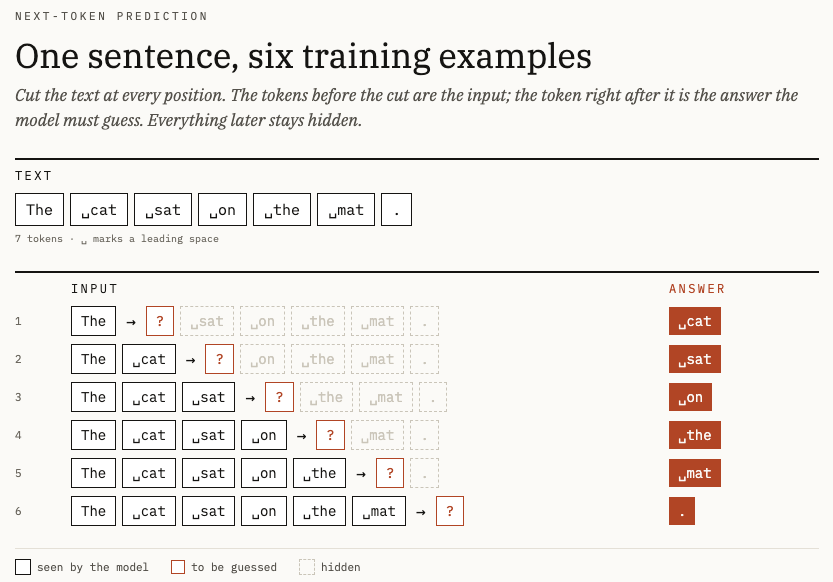
With text, a training example can be just an existing chunk of text; you take the chunk, feed the model part of it, and have the model predict what comes next in the sequence. One chunk of text can thus generate many training examples by feeding the model different portions of the text.
Via Opus 5.5
To train a robot, an example is typically some sort of recording of a task being accomplished or attempted. There are a variety of different methods used to create these recordings and turn them into training data.
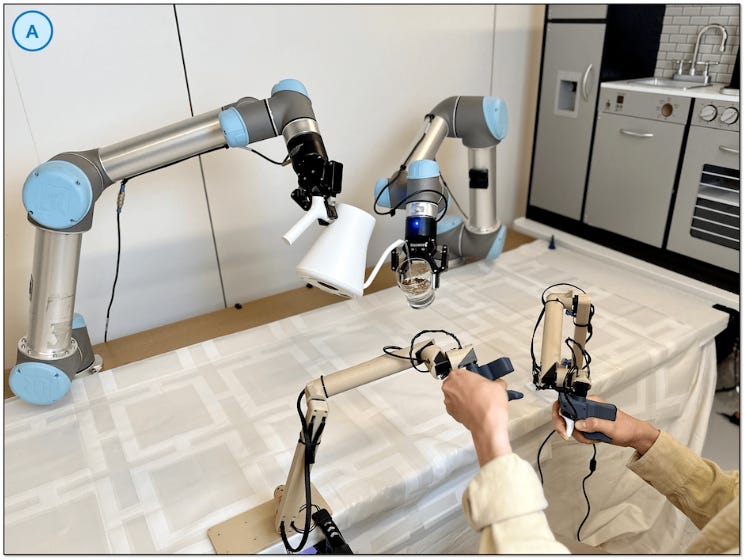
Historically, one of the most common methods for creating these recordings is called “teleoperation.” With teleoperation, a person manipulates some controls that are directly connected to a robot, and uses them to move a robot through some particular task (folding a shirt, picking up and moving objects, and so on). The image below, for instance, shows a person teleoperating a pair of robot arms, using them to pour water from a pitcher into a glass.
Via Wu et al. 2023.
As the person performs the task, data of the robot’s state is recorded, along with images from cameras that are recording the task (often mounted to the robot itself), which are combined to create a training example. An example might consist of feeding a model some data on the robot’s state and what the cameras can see at some particular point in the sequence. The model will try to predict what the next robot actions are (in the form of something like joint angles), and then compare that to what the actual actions were. This sort of training strategy, using examples generated by an expert (a human) and then training a model to mimic them, is known as behavioral cloning, and it’s part of the broader category of “imitation learning.”
Via Opus 5.5.
The major benefit of this method is that the data it generates very closely matches the robot’s actual movement capabilities, because it’s produced from the actual robot you want to train, and it remains widely used today. You sometimes see videos or pictures from huge data collection factories, filled with people doing nothing but teleoperating robots to complete various tasks, and you sometimes see teleoperation accidents when the person forgets that they’re controlling the robot and suddenly moves in a way that the robot can’t handle.
But teleoperation has drawbacks. The biggest one is probably expense: to get the data, you need to have an actual robot, along with a person to sit there and manipulate it, which makes it hard to scale this method to produce very large amounts of data. Another drawback is that it’s somewhat clunky for a person to control a robot this way; they often can’t get any sort of tactile feedback from the object being manipulated to guide their motions, so this won’t necessarily produce really good data on dexterous manipulation. The clunkiness can also make it hard to collect good teleoperation data, and as I understand it, only a fraction of total teleoperation data collected ends up being useful for training.
It’s also possible to generate training data using an existing robot by having it move around on its own, recording its actions, and using some sort of system to categorize these behavioral sequences as successful or not. This sort of strategy, where the robot moves autonomously and you score its actions in some way, is known as “reinforcement learning.” Google was doing something like this around 2016 with an “arm farm”: a series of robot arms moving autonomously, with success scored by whether an arm picked up or grasped an object or not.
This sort of arm farm doesn’t seem to be widely used today, but using real-world deployed robots will probably eventually be the largest source of robot training data. You often hear robotics folks talk about the need for a “data flywheel,” where you have robots deployed in the real world, you use the data from them to train even better models, resulting in more robot deployments, resulting in better models, and so on.
Robotic AI company Physical Intelligence, for instance, is experimenting with this sort of “deploy a robot to do real work, and use it to gather data to improve the model” proto-flywheel at a chocolate factory near its offices. But while this might work eventually, right now there’s a very small number of AI-controlled robots doing anything resembling real work. Real-world data also tends to be extremely repetitive — robots doing the same task over and over again in very similar conditions — which makes it much less useful for training. So for now most data needs to come from other sources.
Another very common strategy for generating robotic training data is simulation: instead of running a physical robot in the real world, run a digital one in a simulated world instead. This is also commonly done with reinforcement learning, in which you have the robot try to navigate some simulated space, after which you score it on how well it does. Another flavor of this is the teacher/student paradigm where you have a “teacher” model that has full access to all the data within the simulated environment, and a “student” model that can only see what the real robot would see (images from its cameras and its own internal state), and you try to get the student to mimic the teacher.
The benefits of simulation are that it’s much cheaper and faster to simulate a robot than it is to deploy one in the real world, and that you can get very large amounts of data by simulating the behavior of thousands of robots. Figure AI taught its humanoid robot to walk via reinforcement learning on thousands of simulated robots. OpenAI taught a robotic hand to solve a Rubik’s Cube via the equivalent of 13,000 years of simulated experience. By 2019, Waymo had driven 10 million miles in the real world, but 10 billion miles in simulation.
Via Figure.
But simulation also has drawbacks. The biggest one is that the quality of the data it produces is a function of the accuracy of the simulation. For some things, such as locomotion (having a robot move through some physical space), simulation is fairly accurate, because the behavior is mostly well-characterized enough that we can represent it digitally. So you can train a quadruped robot to navigate some terrain, or a bipedal robot to dance, or a drone to fly along some path in simulation, and the simulated environment will be a reasonably good approximation of the real world. But for things such as object manipulation (particularly for soft or deformable objects), it’s much harder to build a simulation that accurately captures real-world behavior, and using it as a source of training data is much more difficult. This is generally referred to as the “sim-to-real gap.”
Because of simulation inaccuracies, one popular simulation technique is called “domain randomization.” Since you don’t know what various parameters like friction will be in the real world, you decide to vary the parameters randomly when running the simulation, in the hopes of creating a training envelope that encompasses the parameters that will be encountered in the real world. When OpenAI trained its robotic hand to solve a Rubik’s Cube, for instance, it continuously expanded the range of parameters being tested, forcing the model to learn to solve the cube in more and more difficult environments, in the hopes of giving it capabilities that would generalize to the real world. The robotics team there used this strategy specifically because accurate physical modeling was too difficult:
The biggest challenge we faced was to create environments in simulation diverse enough to capture the physics of the real world. Factors like friction, elasticity and dynamics are incredibly difficult to measure and model for objects as complex as Rubik’s Cubes or robotic hands and we found that domain randomization alone is not enough.
To overcome this, we developed a new method called Automatic Domain Randomization (ADR), which endlessly generates progressively more difficult environments in simulation. This frees us from having an accurate model of the real world, and enables the transfer of neural networks learned in simulation to be applied to the real world.
But despite this technique, and really quite a lot of simulation (13,000 simulated years), performance was only OK — for maximally difficult starting arrangements, success was only 20% — which is maybe why this technique doesn’t seem to be widely used for manipulation training currently. Environmental parameter randomization does seem to be fairly standard for locomotion training though, used for things like randomly varying the coefficient of friction of the surface being traversed.
Another way to use simulation is to create synthetic training data: taking real training data as an input and using it to create lots of similar training examples. Nvidia, for instance, has a page showing how you can use its Isaac GR00T robot simulation platform to generate synthetic robot training data using teleoperation data as an input. Synthetic data generation also seems to be widely used for training autonomous vehicles.
We can also create robot training data by recording humans doing tasks and creating some sort of mapping from the recorded task data to a robot. This might be as simple as fitting a person with a head-mounted camera (creating what’s known as “egocentric video”), and using it to record the person doing various tasks with their hands. The video is then processed so the person’s motions are interpreted as robot motions, and used to create training examples. (This is one reason for the popularity of the humanoid form factor in robotics: humans doing tasks will be a reasonably good source of training data.) Figure AI, for instance, recently announced Index, its program for gathering training data by sending people head-mounted cameras to record themselves doing various tasks (alternatively, Figure will also send a crew equipped with these cameras to your home or business to do chores for you). Companies like Shift are also doing this, sending people with hat-mounted cameras to folks’ houses to record themselves doing chores.
Figure collecting egocentric video data, via Figure.
You can also add more sensors to collect more elaborate human task data. The now-defunct startup Eidon AI stuck sensors on folks’ arms to collect data on joint positions for training robot arms. Neocambrian AI recently announced “Mitts,” which it describes as “state of the art tactile gloves that capture high-precision touch data for robots.”
Via X.
Via X.
Another flavor of this strategy is to use what’s called a Universal Manipulation Interface, or UMI. With UMI, a person holds a pair of specially designed manipulators, that typically have a simple pincer grip at the end (though some have multiple fingers). The person does various tasks with the manipulators, which have cameras mounted to them that record exactly what the manipulators are doing. This video is then used to create training examples for robots that have similar manipulators. Robot model startups Generalist AI and Sunday Robotics, for instance, seem to be primarily using this strategy for gathering training data.
UMI data collection, via Chi et al 2024.
The benefit of using human-collected task data is that it’s much cheaper to collect than teleoperation data: all you need is a camera, or some camera-equipped manipulators, rather than an entire robot. And it’s probably much easier to get a wide variety of different task recordings by just having a person walk around and do different things, rather than constantly repositioning a robot to do them. And because the data is gathered in the real world, by people manipulating real objects, it’s more accurate than simulation. The drawback is that because this data comes from a person rather than a robot, it won’t map onto a robot’s capabilities perfectly well. Even UMI, which minimizes the human-robot differences by having a person do tasks using a sort of robotic manipulator, won’t necessarily map perfectly, though the discrepancy is small and many of the most impressive robotics demos we’ve seen (such as Generalist AI’s) have been trained using UMI data.
It’s possible to use multiple training strategies in a single robot model. Agility Robotics’ Digit, for instance, walks using a small, 1-million-parameter neural network trained in simulation using reinforcement learning, while object manipulation seems to have been trained using behavioral cloning. Dyna Robotics similarly seems to have used a combination of reinforcement learning in simulation and human video for training data.
It’s also often useful to train a robot model using data other than task completion data. Vision-Language-Action models, as we noted earlier, are built from Vision-Language models trained on text and images. And because of the ubiquity of general video data on things like YouTube or TikTok, there’s a great deal of interest in finding ways to use generic web videos as a source of training data. Nvidia’s Cosmos, for instance, is a foundation model trained on video data that can be used as a backbone for a robot policy model.
Robot dataset sizes
How much of this action-relevant training data have we gathered so far, and how much do we need?
As with AI models more generally, robotic training datasets seem to be getting bigger. An early dataset that was considered large at the time was the Open X-Embodiment (OXE) dataset, created by Google DeepMind in 2023 by stitching together dozens of existing datasets. OXE consisted of over 1 million robot action trajectories spanning more than 160,000 different tasks, totaling around 4,000 hours’ worth of task data. Physical Intelligence’s Pi 0 model,
https://www.construction-physics.com/p/how-to-train-your-robot
Welcome to Brian Potter (Unofficial) spacestr profile!
About Me
Unofficial automated RSS/Atom links to Brian Potter's work on Brian Potter’s recent essays explain building technology/history and applied science. Original work is credited at the source; follow the source links. Zaps support the independent feed operator, not the author.