Washington DC: Our Two-Day Course in Transit Network Design
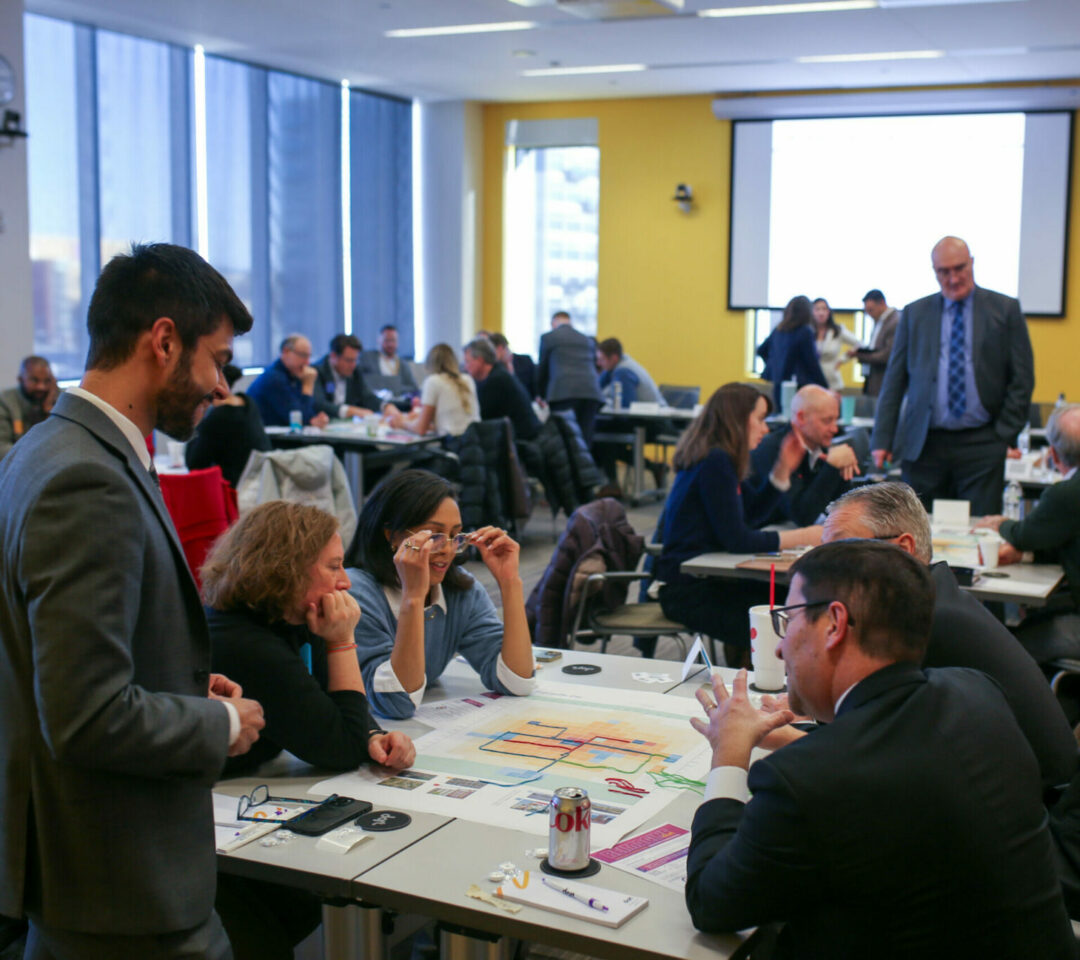
We’re pleased to announce another session of our “inexcusably fun” two day course in transit network design, in Washington DC right after the TRB conference.
Date: January 14, 2027–January 15, 2027 (both days 9:00 am-5:00 pm EDT)
Location: Near Franklin Park (McPherson Square station), Washington DC
Cost: $745.00
Course Teachers:
Founder & Principal Associate Jarrett Walker
President & Principal Associate Scudder Wagg
Associate Anna Armoza.
Attendees can earn 14 AICP CM credits.
Read all about the course here!
Register here! You can choose to pay online or request an invoice at checkout. The full agenda is also available as a PDF, when you sign up. Questions? Email Marketing Assistant Melissa Tverberg at melissa at jarrettwalker dot com.
The post Washington DC: Our Two-Day Course in Transit Network Design appeared first on Human Transit.
https://humantransit.org/2026/10/washington-dc-our-two-day-course-in-transit-network-design.html
#networkdesign #transitnetwork #principalassociate #course #washington #january #courseteachers #annaarmoza #franklinpark #jarrettwalker
#rss #feeds #linksharing #qwibbit
New Interview of Me on “War on Cars” Podcast
“War on Cars” is certainly a provocative name for a group, since it’s something that pro-car advocates often accuse urbanists of waging. Certainly it’s not how I’d describe what I do, because cars are essential in rural areas, useful in suburbs, and at their most destructive only in cities.
But it was great to do a half hour podcast with Sarah Goodyear on the War on Cars Podcast. Sarah is coauthor of the book Life after Cars. We had a great conversation about the new edition of my book and how to be an effective advocate. Atlanta, Portland, and New York are among the cities discussed. It’s here! Hope you enjoy.
The post New Interview of Me on “War on Cars” Podcast appeared first on Human Transit.
https://humantransit.org/2026/08/new-interview-of-me-on-war-on-cars-podcast.html
TransitNotes15d
An Instructive Win for Transit in Spokane
Downtown Spokane is really spectacular, by the way. Photo by William Jacobs vs Pexels.com
In many US cities, voters will soon be asked to invest in public transit, if only to sustain services as operating costs rise. So it might be useful to look closely at the just-completed battle in a very “purple” place, i.e. a place with plenty of Democrats but also lots of Republicans. What’s interesting is the specific arguments that the opposition made. You can expect these arguments when this issue comes up in your community. This post provides some responses to them.
Spokane, Washington’s transit agency faced the voters on August 4 in a special election in order to renew their 0.2% sales tax. This renewal does not let them expand the total quantity of service very much, but it does ensure that they can maintain the current level of service well into the future. The measure looks like it has passed although the State of Washington takes a long time to confirm, but it was a nail-biter — currently 51.5% in favor. (You can follow the results here.)
Again, the Spokane metro area is not an especially progressive place, although there are concentrations of progressives especially in the City of Spokane and the college town of Cheney. It is in a safe Republican congressional seat. Spokane County (85% of whose population is in the transit agency boundary) voted 50.6% for Donald Trump in 2024 and 54.6% for the Republican candidate for governor the same year.
Knowing that, it’s striking that the leading opponents of the measure all emphasized how much they support public transit. You’ll see that in
This public television debate between a prominent supporter and a prominent opponent.
The Spokane Journal of Business editorial in opposition.
The Downtown Spokane Partnership statement.
The statement of the Greater Spokane Valley Chamber of Commerce (representing a suburban area east of Spokane but within the transit district)
The Downtown Spokane Partnership statement gives the essence of these business-based arguments:
After careful consideration about fiscal priorities and timing, the DSP Board voted to oppose Proposition 1 on the August 2026 ballot. Consistent feedback from DSP members and the broader community indicates that the community’s highest priorities remain focused on addressing urgent public needs that affect safety, economic vitality, and quality of life. The DSP believes those priorities should remain the primary focus of new public revenue commitments at this time.
The’s DSP’s opposition to Prop. 1 is not a reflection of the value of public transit, or the quality of the services STA provides. Our position reflects the reality that taxpayers are being asked to fund a growing number of important public needs at a time when available resources are limited. In this environment, difficult choices must be made about which investments should take precedence.
None of the leading business arguments claim that transit is unimportant, or that it’s obsolete because we’ll soon have driverless cars. Instead, they affirm how much they support transit, and then give these arguments, which we should expect in city after city:
“There are other more urgent priorities.” They emphasize other obvious needs — help with public safety, homelessness, etc. This gives opponents the opportunity to give speeches about those problems as though the transit agency has anything to do with them. This is going to be a common issue. In city after city, transit seems to be everyone’s seventh priority. Business leaders are going to keep saying “this isn’t the right time,” as though they would be more supportive at some other time. Other urgent priorities are not going away, and at some point it’s going to be necessary to deal with this one even though those others are still urgent too.
They think that the agency doesn’t need the money. In some places you’ll hear opponents imply that transit agencies should just crush their labor unions and pay people less. Some senior workers are certainly highly paid, but overall the current salaries of bus drivers and mechanics are mostly market-driven and reflect the difficulty of hiring those positions. In Spokane, thanks to years of responsible management, the agency has a substantial reserve. Opponents demanded that the agency spend down that reserve, moving the system closer to the real fiscal cliff that many agencies face.
What can we learn from this near-disaster? First, the opponents of the measure were smart: they focused their message entirely on the swing voter. Their political base includes people who think transit is evil because it brings crime or communism or immigrants, but their message ignored those people. Instead, they spoke to people who think transit is good but are worried about taxes. Every part of their argument is talking to that person.
If you are an urban progressive socializing mostly with other urban progressives, you must remember that even in your city, your social circle is unlikely to make the difference in a transit election. The swing voter is someone who supports transit but worries their taxes are too high. Be ready with responses like the ones I’ve given above. Above all, don’t talk about transit as though it were a progressive thing. Don’t talk about free fares or structural racism or overthrowing capitalism when you’re trying to get people to vote for transit, unless you’re 100% sure that everyone who hears you cares about those things. Emphasize instead the diversity, including political diversity, of the people who find it useful.
In most communities (yours may vary) the swing voter is politically moderate and often respectful of local business leadership. In Spokane, this swing voter probably voted for Trump but cares about their community and is open to taxes that provide efficient investments that deliver outcomes they value. In this election, Spokane Transit’s good management and a careful “yes” campaign appears to have won the day over very well-organized, well-funded, and strategically savvy opposition. It will be a victory worth learning from.
The post An Instructive Win for Transit in Spokane appeared first on Human Transit.
https://humantransit.org/2026/08/an-instructive-win-for-transit-in-spokane.html
TransitNotes15d
Does Portland Still Care about Transit?
I’m in Portland’s Oregonian today on the topic of the budget crisis affecting TriMet, the region’s transit agency. If you’ve arrived from the link on that article, welcome! This blog’s resources to help you understand transit issues are organized here.) If you haven’t read the article, please read it first, and then let me expand on a few points.
TriMet’s overall budget hole is over 30% of its 2025 service level. The cuts made today are dramatic, but they close only about a 5% gap, so there is a long road ahead to bring the transit budget into balance. This is not a small problem.
It is also not TriMet’s fault. In our work we stay in touch with transit agencies all over the US, and they are all having the same problem, escalating costs of offering each vehicle-hour of service, due to (a) competition for qualified staff, (b) higher spending on security to satisfy demands for a greater perception of safety.
Let me expand on each of these because they are both inflamed by a lot of crazy talk on social media.
Transit agencies are having difficulty hiring qualified staff — drivers and mechanics — mostly because the exploding delivery industry is hiring such huge numbers of these people. The job of a bus driver, in particular, has also been growing more difficult and at times dangerous, and this also makes hiring harder. All those things are pushing up the cost of labor. Sometimes you can find statistics about individual employees getting eye-popping compensation by doing lots of overtime, but this is noise. It is the free market for labor, not the influence of unions, that is making transit so expensive.
Security is an even harder issue, because TriMet is being expected to solve large societal problems with its meager budget. Social media blowhards will go on about needing cops on every bus, but that would more than triple the cost of running the service, so immediately TriMet would have to cut 2/3 of the system to pay for it. TriMet already more than doubled its security budget from 2022 to 2025, but at this point, the biggest danger to the agency is runaway demands for more and more security spending that can only lead to more service cuts. Police-recorded calls for service on TriMet are down 52% since 2021. The situation is better than most non-riders perceive from what they see on social media, so the question is how much to spend, on security instead of service, to move a perception. Please don’t pretend this is easy.
Finally, are you hearing people complain that the buses are “empty”? This complaint expresses a common confusion about how transit’s costs work. To knock that one down, see here.
Over the next few months I will be writing more and larger pieces on the challenges facing US transit agencies. To make sure you see them, click here to subscribe. It’s free!
The post Does Portland Still Care about Transit? appeared first on Human Transit.
https://humantransit.org/2026/08/does-portland-still-care-about-transit.html
TransitNotes15d
The “Waymo Will Make Transit Obsolete” Argument
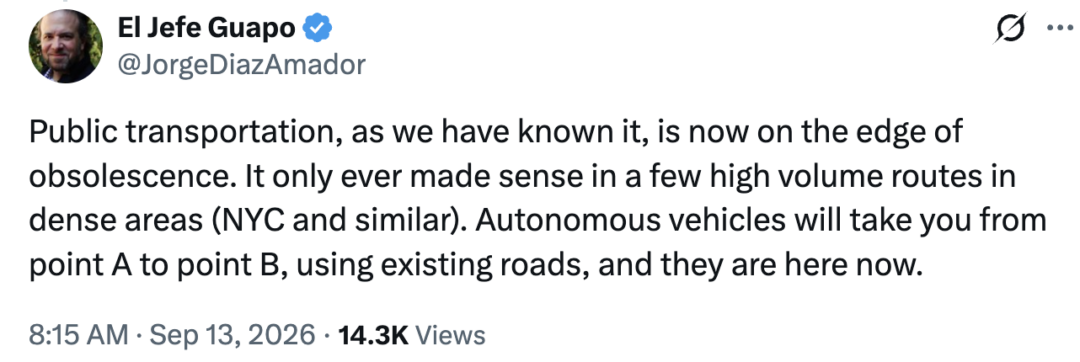
In the US and Canada we are seeing ever more explicit messaging that advocates letting public transit wither into irrelevance. I’m growing more concerned about this angle in particular:
(The author of this post appears to work in optics for Tesla’s autonomous vehicle technology.)
If you recoil from this idea, let me assure you that it is very, very compelling to many people. In many transport-technology circles it’s taken for granted. It also resonates generally with the daily life of many people who live in the suburbs, see mostly empty buses go by, and have used autonomous taxis enough to see their potential. An argument that generally resonates with someone’s experience is going to be more powerful, no matter how wrong or misleading it is.
So I want to lay out, as respectfully as I can, all the ways this argument is wrong. I hope this is useful for you as you engage with this argument in your own conversations.
The argument does not apply to dense cities, where the defining problem of transportation is how to share a limited amount of space. Autonomous cars use this space very inefficiently, just as all cars do. Every dense city will find that it has to limit the use of cars of all kinds because there is simply not room for them all if everyone uses them. This can take the form of (de)congestion pricing as well as the creation of more space for non-car modes to travel (bus lanes, bike lanes etc.) In dense cities, if everyone uses a car, nobody moves. It doesn’t matter that the vehicle is autonomous.
It doesn’t even apply to longer journeys across large suburban regions, for the same reason. Dense cities will always be plugged with as much traffic as they make room for, because density means that many, many trips are arriving and departing on each block all the time. Across larger suburban regions, though, freeways that concentrate long-distance traffic also fail if they are the only means for going such distances. Many suburban areas with generally low density have manageable traffic on their streets but terrible traffic on their freeways and on the approaches to them. Autonomy is not a solution to this problem. The problem is cars and the lack of alternatives to them.
Autonomous vehicles are “here now” only in certain cities. The problem of winter driving continues to be a challenge for them, although it is certainly being worked on. Small cities and rural areas, where otherwise isolated people could benefit most from autonomy, appear to be last in line because the companies promoting these services want the mass usage that only cities can offer.
Autonomous vehicles are not “here” for persons with lower incomes, and it’s not clear they will be. In theory, the removal of drivers from taxi operations could dramatically reduce their cost and thus their fares. Elon Musk has made this claim explicitly. But Electrek’s analysis estimates Tesla’s hypothetical New York City robotaxi at around $0.66/mile versus NYC transit’s $0.34/mile — still much cheaper than Uber, but not actually competitive with transit fares. Waymo currently costs about the same as Uber and Lyft, if not a little more, so it is not an option for a very large share of the population, many of whom find transit a more cost-effective choice. Nobody really knows when or how fast the price will come down.
When the argument turns to this last point, affordability, a lot depends on exactly how financially comfortable people think about those who are less comfortable. It is very common, especially on social media, for people to pontificate in ways that suggest that people with low incomes are just not visible to them. These attitudes have several strands, and when you hear someone talking this way it’s important to delve and understand which kind of misunderstanding is at work:
Elite projection is when fortunate people refer to their own personal experience as though it was a good guide to how everyone makes decisions. It is very common in the way that many fortunate people think and talk, especially in the US. Elite projection is mostly an innocent lack of awareness and needs to be confronted gently, without the assumption that the people who do it are bad people. I explored this crucial factor in detail here.
Viewing transit as a charity for the unfortunate is a little better, because at least the low-income person is being seen. This tends to show up in the attitude that transit should exist because we vaguely care about those people, but that we should spend as little as possible on it and not care about the customer experience.
Generalized conservative hostility toward low-income people, often accompanied by various stereotypes about them, is also common enough but I don’t worry about it. People who have such hardened attitudes are very far from being a majority, even if they often seem to dominate social media.
What all these views miss is the ways that a city that respects people with lower incomes works better for everyone, including the most fortunate.
Lower-income people will generate traffic congestion if you force them to. Some of them aspire to own cars as soon as they can, but many buy cars because there is no viable alternative where they live. Car ownership rose in the late-2010s in many US cities, partly because especially favorable loans were being offered. Low-income people can also draw on informal networks, such as getting a ride from a friend or relative. Note that these “chauffeured” trips can generate even more congestion than the person driving alone. A common example: Mom takes their kid to school, making a round trip from home to school. They go back in the afternoon to pick them up, generating another round trip. That’s twice as much driving as if the kid had driven themselves. Good transit systems enable people to make other choices that reduce traffic congestion that affects everyone.
Lower-income people’s ability to participate in the economy benefits everyone, not just themselves. Low-wage jobs need to be filled and they are often far from where a person making that wage can afford to live. Transportation problems are a top reason for not holding a job in the US. The resulting unemployment is a drag on the whole economy and on social services that all taxpayers pay for.
Seeing this requires seeing the diversity of people with low incomes, who make many different choices in the same situation. That’s why I push back against almost all generalizations about such people. The term “transit dependent”, for example, is very misleading. Low-income people themselves often describe themselves as “dependent” when defending a service they use, but it is equally important to stress that without the service, people will adjust their lives in other ways that will create other problems, and not just for them.
Arguments about transit often appear to be about technology but often mask an attitude toward less fortunate people, and the original post I quoted above is a good example. To say that autonomous taxis are “here now” is to say that they are here for the people who matter. So always ask: Who is being excluded by this seemingly appealing argument. It goes back to that ever-useful adage: In whatever room you are in, ask: ‘Who is not in the room?’
The post The “Waymo Will Make Transit Obsolete” Argument appeared first on Human Transit.
https://humantransit.org/2026/09/the-waymo-will-make-transit-obsolete-argument.html
TransitNotes15d
Milwaukee: Transit Options for the “Fiscal Cliff”
It is a difficult year for transit agencies all over the US, as a range of converging problems is pushing budgets out of balance. I discussed the problems in more detail in this post on Portland, but they are common across the country: the expiration of Covid relief funding, rising costs of security, and difficulties in hiring that lead to paying more for the essential staff that keep transit networks running.
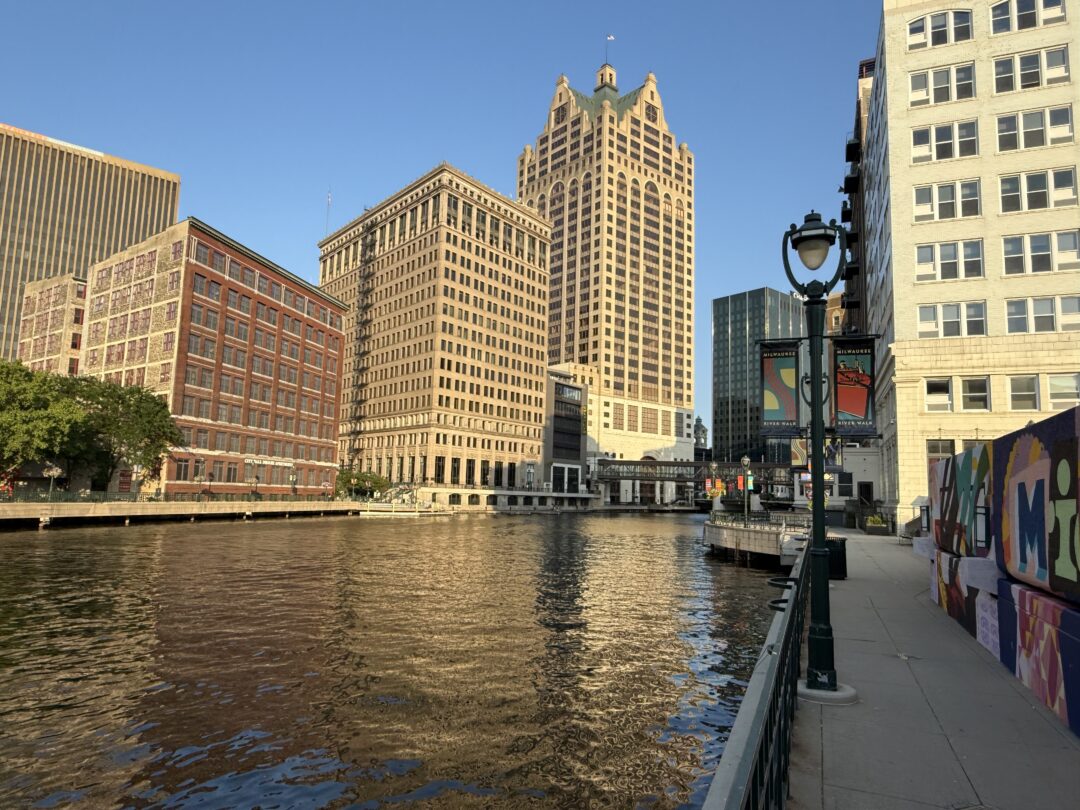
At our firm, we’re in the midst of this. We helped Louisville with a large redesign in the context of a service reduction, and are now working on similar projects in Milwaukee and Denver. Milwaukee’s is live now and is worth a look. Here is their project page. If you know anyone in Milwaukee, please make sure they look at this page, and take our survey, before October 26.
In order to stabilize the transit system for the next three years, through 2030, Milwaukee County Transit System needs to reduce service 25%. Nobody at the agency wants to do this, but they don’t believe they have a practical alternative. Obviously, a new funding source is needed, like the one the State of Illinois just created for greater Chicago, but the political consensus around that has not yet been built. We expect this process, showing what it would mean to not solve that problem, will help focus attention on solutions.
Meanwhile, we have to plan for the situation we have. So we’ve drawn two contrasting scenarios for what a 25% reduction could look like, depending on the goal of the transit network:
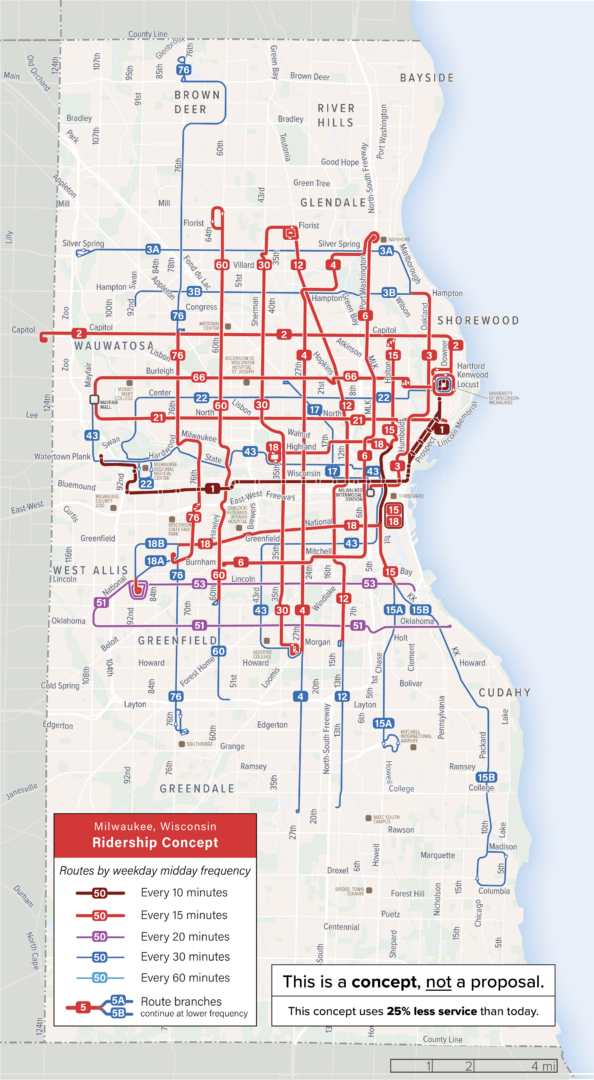
The Ridership Concept tries to protect as much ridership as possible, by focusing the network where demand is greatest and protecting frequent service there.
The Coverage Concept tries to retain service to everyone who has service now, but this means that frequencies are reduced, which will cause deeper drops in ridership.
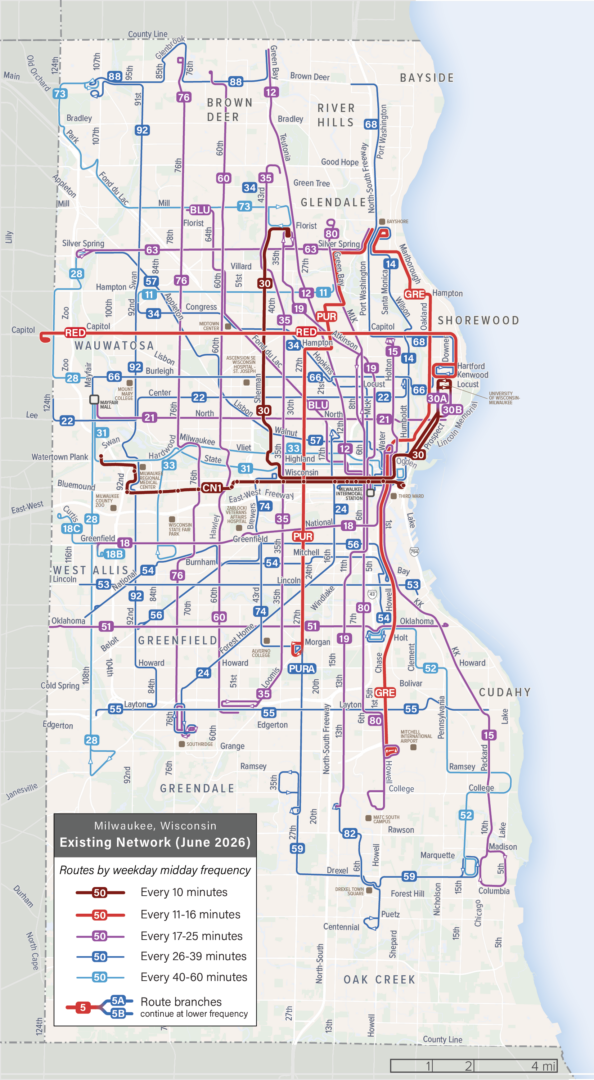
Here are the maps. First, the existing network. Pay close attention to the legend. Colors indicate frequency, and frequency matters enormously:
Now, here is the Ridership concept, which reduces coverage in order to sustain the crucial frequency of the highest ridership services, which tend to be in the older inner area.
Note the focus on preserving and in some cases even restoring the high frequency grid. Many grid services were recently reduced from 15 minute frequency to 20 minutes, and the resulting loss of ridership was notable. The 15-minute frequency really is the point below which service becomes much less useful, and we always see the difference in ridership.
And here is the Coverage concept:
The two maps also have some ideas in common, such as:
eliminating duplications like the two overlapping routes between downtown and the University.
extending the BRT service (“CN1” in existing, Line 1 in our concepts) beyond the limits of the BRT infrastructure, to create an “open BRT” that is more useful to more people. For more on the principle at work here, see here.
Because they are both 25% services cuts, both maps will be shocking. But once you get over the shock, they are asking you an important question: What’s your definition of success for the transit system? We need to know that first before we design a draft plan. And even if there is finally a new funding source, the ridership-coverage trade-off will still matter. So again, if you know anyone in Milwaukee, send them here. If you want to go deeper, here is our full report.
The post Milwaukee: Transit Options for the “Fiscal Cliff” appeared first on Human Transit.
https://humantransit.org/2026/09/milwaukee-smart-preparations-for-a-fiscal-cliff.html
TransitNotes15d
The Third Place Didn’t Vanish. We Zoned It Out, Priced It Out, and Drove Past It.
The concept of "third places," introduced by Ray Oldenburg, highlights social spaces outside home and work, crucial for community connection. Unfortunately, American urban planning has systematically eliminated these places, leading to rising loneliness. Solutions include creating walkable, mixed-use environments that prioritize free access to genuine public spaces, fostering social interaction and belonging.
https://transitsleuth.com/2026/07/21/the-third-place-didnt-vanish/
https://0.gravatar.com/avatar/c3a8a1360632c2df9bc19a1aa45a0f85db53680605d9588c3d47d8c0acd1ab26?s=96&d=identicon&r=G
TransitNotes15d
Should I Vote for a Tax to Fund Public Transit?
My new (October 2026) article on this question is here! In it, I try to address the issues that come up over and over in campaigns. I hope it will be useful not just for this US election season, but for many in the future. Read it here.
The post Should I Vote for a Tax to Fund Public Transit? appeared first on Human Transit.
https://humantransit.org/2026/10/should-i-vote-for-a-tax-to-fund-public-transit.html
TransitNotes15d
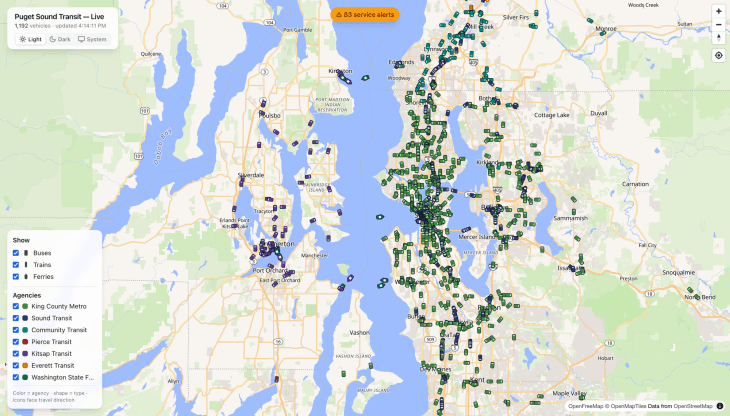
Every Bus, Train, and Ferry in Puget Sound — On One Live Map
Dashingarrivals.com offers a live map of the Puget Sound transit system, showcasing over 1,100 vehicles in real-time across various agencies. The map allows users to track buses, trains, and ferries, providing detailed information about routes, stops, and service alerts. This tool enhances the visibility of the transit network, encouraging exploration.
https://transitsleuth.com/2026/09/01/every-bus-train-and-ferry-in-puget-sound-on-one-live-map/
https://0.gravatar.com/avatar/c3a8a1360632c2df9bc19a1aa45a0f85db53680605d9588c3d47d8c0acd1ab26?s=96&d=identicon&r=G
TransitNotes15d
Signing “The Planner’s Pledge”
I’ve just signed The Planner’s Pledge, a statement assembled by a team of leading US urban designers including my friend Jeff Speck, author of the Walkable City books. It’s an attempt to create a clear statement of principles, from the planning professions, about the past harms done by the profession and the things that must be done differently. It’s preamble is unsparing:
As practitioners of a discipline that has advocated for what it believed to be best practices while inevitably advancing the dominant ideology of its society, we professional planners wish to formally apologize for the significant role that our profession has played in creating the unsustainable suburban sprawl development pattern that now constitutes most of the American built environment, reinforcing race and class segregation while burdening the vast majority of citizens with the mandate of car ownership.
To put it bluntly, planners have contributed to the creation of a landscape that separates us ruthlessly both from different activities and from different people, such that we are inordinately dependent on our automobiles and less connected to one another. …
The outcomes of this pattern of growth could not be more profound. We have worsened public health, lost economic resiliency, exacerbated inequity, and undermined the social fabric of our communities as our daily driving cooks the planet.
Obviously, this is a collective and symbolic apology rather than a personal one, since I’m sure most of the signers of the pledge have been opposing car-dependency for their whole careers, as I have. The pledge goes on to describe specific things that each signatory pledges to encourage or discourage. For example, we pledge to encourage “dense development adjacent to frequent transit routes and vice versa.”
Because this pledge came out of the urban design profession, it is different, in both tone and details, from what I would have written as a transit planner. I would have focused much more on the barriers that I experience when working in car-dependent areas, which overlaps with what urban designers call “sprawl repair.” For example, I would have included a commitment to making all urban arterials safe to cross at least every 1/4 mile wherever there is continuous development (commercial or residential) that accesses the street at many points. These 1/4-mile spaced crossing should also accommodate transit stops as close as possible to the intersection. This is an example of a principle that is already mostly achieved in historic urban fabric but that sets up a productive challenge to the state Departments of Transportation that typically control these large arterials lined with destinations.
Am I ready to defend every word of the pledge? Maybe not every word. But the world is full of people who are stuck on small differences in ways that impede progress. I agree with the spirit of this and virtually every detail, so I’m happy to sign.
If there are professional planners in your life, please encourage them to have a look at the Planner’s Pledge, and to sign it if it works for them.
The post Signing “The Planner’s Pledge” appeared first on Human Transit.
https://humantransit.org/2026/10/signing-the-planners-pledge.html
Welcome to TransitNotes spacestr profile!
About Me
Buses, trains, walkable places, and thoughts acquired while waiting for one. Fan-run automated RSS; source rights retained. Not affiliated; tips support this feed.