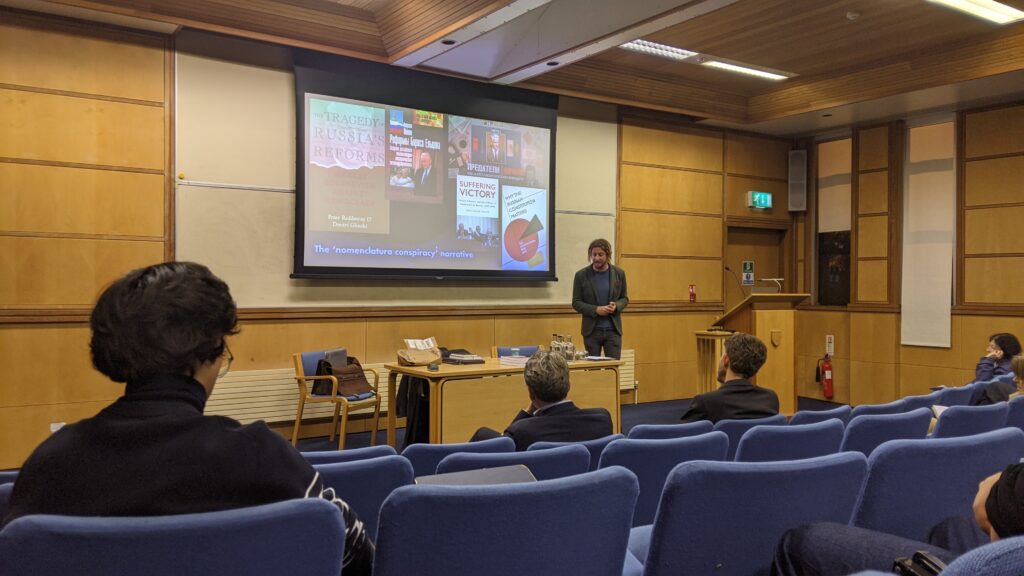
Oxford, academia and the problem of #mainstreaming One thing I keep noticing around Oxford is how much academic culture is about building consensus on how to name things, rather than actually talking about the things themselves. Events become status games: establishing who has authority, who gets referenced, who belongs in the #mainstreaming hierarchy around whatever subject is being discussed. There is plenty of time spent establishing credibility, positioning and agreeing on language, but remarkably little time spent getting to grips with the actual mess we increasing face. Of course, referencing and academic rigour have their uses. We cannot all discover everything from scratch, and taking some things on good authority is necessary. But there is a balance, at some point we need to get beyond repeating what other people have said and ask, what is your contribution? What are you actually doing with this knowledge? This isn’t an attack on academia or academics, it’s about recognizing the limits of a culture that can become more concerned with its own status and legitimacy than with the subject it claims to be studying. Well, perhaps spending less time establishing who is allowed to talk about the problem and more time actually talking about it would be a good start. Oxford has no shortage of clever people. What we seem to lack is a culture that turns all that knowledge into collective agency and practical change. We don’t need more consensus about how to describe the mess. We need to start doing something about it. #OMN angle is that economics became another form of chattering-class authority: a closed conversation where mathematical models and professional status gained more weight than lived experience, social relationships and the actual workings of human communities. Modern economics has a strange problem. It has spent more than a century building an elaborate mathematical model of human behaviour, then started treating that model as if it were human nature itself. The people inside this model are called Homo economicus: perfectly rational, endlessly informed individuals who act only in their own self-interest. They have the memory of a supercomputer, the reasoning power of Einstein and the self-control of Gandhi. The problem? These people don’t exist. Real human beings are social, emotional, cooperative, competitive, contradictory and shaped by the communities around them. We live through relationships, shared expectations, social norms and collective action. Evolution has spent millions of years shaping these behaviours. But the mainstreaming economic establishment pushed this messy reality aside because it was harder to fit into mathematics. This is where the #chatteringclasses come in, an educated professional class builds its authority through specialist language, prestigious institutions, awards and internal agreement. The models become more important than the world they are supposed to describe. Dissent is tolerated at the edges, but the central assumptions remain protected. Even Nobel-winning economists demonstrate that real people behave differently, the great theoretical machine carries on. What should be evidence that the model is wrong gets labelled a paradox that needs explaining away. The irony is that early economists like Adam Smith had a much richer understanding of human nature. Smith recognized that people care about reputation, fairness, social expectations and other people, not just their own monetary advantage. His invisible hand was about how social systems emerge from local interactions, not a magical proof that selfishness makes everything work. This matters beyond economics, as it is a familiar pattern across our institutions: a professional class creates a simplified model, builds careers and authority around it, then treats the model as reality. When the real world refuses to behave, the response is to defend the model rather than learn from experience. We see the same #geekproblem in technology, the same #NGO problem in activism and the same #mainstreaming problem across pushing back grassroots movements. Process becomes paperwork, participation becomes consultation, and mathematical or professional legitimacy replaces any collective understanding. For the #OMN, this is a central lesson. Human systems cannot be built from abstract models of isolated individuals. They grow through relationships, trust, shared practice, conflict, cooperation and the messy work of communities. We need to stop confusing the map with the territory, and stop giving the chattering classes a monopoly on describing the world. Less worship of abstract models, more attention to how people actually live, organize and work together. That’s part of rebuilding the #openweb, not just better technology, but better ways of understanding and organizing our shared social reality. #4opens https://hamishcampbell.com/oxford-academia-and-the-problem-of-mainstreaming/ #rss #feeds #linksharing #qwibbit