spacestr

šŸ”” This profile hasn't been claimed yet. If this is your Nostr profile, you can claim it.

Edit
Dan Thurot (Unofficial)
Member since: 2026-10-16
Dan Thurot (Unofficial)
Dan Thurot (Unofficial) 6h

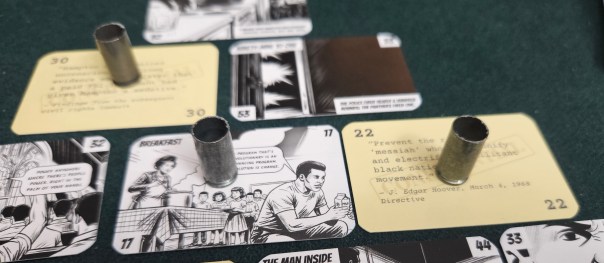
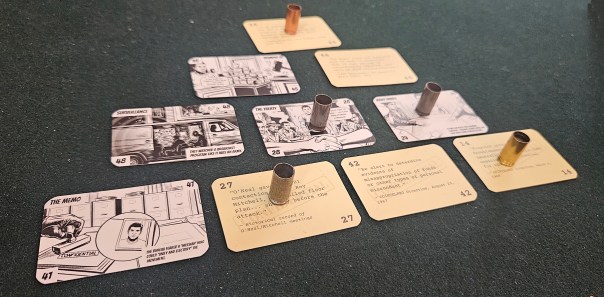
Abstracts Get Political: COINTELPRO I don’t often receive boxes of bullets in the mail. Or even boxes of bullet casings. Because COINTELPRO: The Assassination of Fred Hampton doesn’t actually include bullets, only the spent brass that would normally hold the projectiles. When the game arrived, I hefted the entire handful. Ten casings, nine millimeter, five different manufacturers. Primers burnt. Cordite faint but noticeable. Fred Hampton was shot four times. Twice in the initial barrage from outside the apartment where he slept, possibly drugged by his head of security and FBI informant William O’Neil; twice more at close range after officers realized he was still alive. He was the deputy chairman of the Black Panther Party of Illinois, but the crime that had drawn the FBI’s attention wasn’t any particular clash between the Black Panthers and the police, nor even the Rainbow Coalition he had formed with poor white Southerners and Puerto Ricans. No, it was the party’s Free Breakfast Program for neighborhood kids that had drawn J. Edgar Hoover’s ire. Building the Chicago chapter of the Black Panther Party… and infiltrating it. COINTELPRO: The Assassination of Fred Hampton is a board game designed by Keith DeViere Donaldson and illustrated by Jane Kenn. Unlike most board games that tackle serious topics, it isn’t the domain of multi-use event cards and global maps. Matthias Cramer’s Watergate lands a bit closer, but still doesn’t quite capture the deep abstraction of Donaldson’s approach. If anything, this belongs to a different tradition, one simultaneously older and more radical. This is the domain of games like Suffragetto, with its rows of truncheon-wielding bobbies and martial-artist suffragettes. Like Guerrilla Checkers, with its general infantry marching along different leylines than its slinking insurgents. Which isn’t to say the game isn’t evocative. Quite the opposite. There are two sides. One player is Fred Hampton. The other is William O’Neil. The board is presented as a pyramid of ten cards, drawn and constantly refreshed from a deck of sixty. These cards are evenly divided between two dramatically different aesthetics. Hampton’s cards, illustrated by Kenn, are portrayed as panels from a graphic novel about the deputy chairman’s life. In one, he speaks at the funeral of a slain comrade; in another, he shares his famous quote about how you can kill a revolutionary but not the revolution. The others are shown as memos within the FBI, typed and sterile and hidden from public disclosure. These cards, once arranged on the table, become a conceptual representation of the Black Panther Party of Illinois. When a bullet is on a card, it has been infiltrated. O’Neil’s goal is to infiltrate the entire organization. Hampton’s is to clear the board or, barring that, to survive until the deck has been emptied. What follows is a tense dance between Hampton and O’Neil. By removing cards from the pyramid, others tumble into their place. This lets both sides manipulate the structure of the organization, but never with much ease. Meanwhile, the placement of O’Neil’s bullet casings becomes a matter of utmost importance. At the end of every turn, whichever side controls the most ā€œcleanā€ cards at the bottom of the pyramid gets to either add or remove another casing. The problem for Hampton is obvious, but organizational corruption also prevents O’Neil from commanding as much sway as he would prefer. Back and forth it goes, cards and casings shifting, until the noose either cinches tight or slips free. Hmm. Suspiciously political, if you ask me. It’s easy to be dismissive of abstract games. When playing COINTELPRO, there’s little need to think about the particulars of Hampton’s assassination. How many of the Black Panthers’ most violent engagements were directly encouraged by O’Neil, for example, or the backdrop of oppression that functions as necessary context for the rest of the game. Devoid of background, don’t these games dissolve into something else entirely? To some degree, this is true. One doesn’t need to read the damning FBI memos or sequence the graphic novel to receive a flipbook overview of Hampton’s life, accomplishments, and betrayal in order to operate COINTELPRO purely as a wind-up monkey. Of course, that misses the point of many board games. But it would also be a mistake to brush off Donaldson’s design as overly abstract. When examined closely, a number of little touches put the player in the headspace of its actors. For one thing, COINTELPRO is subtly asymmetrical, giving both sides access to a private action that can do as much harm as good. For O’Neil, this is his ability to escalate the party’s activities. This adds another bullet to the board, but at the price of discarding a pair of cards from the deck. In essence, he has encouraged more radical action, putting the party in danger, but also made it more likely for Hampton to survive in the long run if he can overcome the current crisis. Meanwhile, Hampton can ā€œbad-jacketā€ his cards, removing a clean Black Panther to also sweep a bullet from an adjacent card. By casting suspicion on his own people, he slowly isolates the bad apples tossed into the barrel by O’Neil — usually a bad idea, but one that can prove useful when Hampton’s back is against the wall. But the real distinction is born out in the basic gameplay. Simply put, it’s easier to build than to destroy. Hampton’s goal is to create something durable, while O’Neil’s is to chip away at the foundations until the entire structure comes crumbling down. This quickly gives both sides a distinct emotional register. Playing as Hampton is an exercise in frustration: you carefully position your cards, ensure the removal of any one operative won’t result in catastrophe, and then watch as your unseen foe still manages to undermine your best efforts. On the other side, playing as the informant feels weaselly and cheap. It helps that the basic game is unbalanced in O’Neil’s favor, placing the extra brawn of Big Brother on his side. Curiously, there’s an advanced variant that includes a card market that allows Hampton and O’Neil to replace unfriendly cards. This is the more balanced way to play, but it also sheds Hampton’s sense of swimming upstream. I’m glad it’s included, if only because it gives us little dials that show Hampton and O’Neil directly. But it feels like a concession to those who bellyache nonstop about balance. There was nothing balanced about the contest between Fred Hampton and the surveillance apparatus of the United States. The clue’s in the name. COINTELPRO, the FBI program that infiltrated and discredited progressive organizations, may have been discontinued in ’71, but when we have ICE agents infiltrating church services and union meetings, it seems very little has changed in the intervening half century. The advanced mode lets players swap out cards from a market. In any case, the result is quite the thing. COINTELPRO: The Assassination of Fred Hampton is not only a worthwhile board game, but also a delayed growl of frustration at the injustice of a country that manufactures the consent to murder its own citizens for the crime of filling empty bellies. Fred Hampton’s final days could have been shaped into a more traditional experience, but there’s something to be said for this incarnation in particular. For the world of difference between Kenn’s comic-panel illustrations and the direct words of the people who murdered him. For the cordite-dusted bullet casings that serve as play counters. As for those counters… they are such small things. I’ve discharged thousands of those casings in my life. Tens of thousands. I know their shape and heft. Five to six grams. Between 80 and 90 grains. I’ve swept them into baggies for friends and family members to reload, pinched them from brush and dirt. And they never weighed so much as they do in this strange and arresting board game. A complimentary copy of COINTELPRO: The Assassination of Fred Hampton was provided by the designer and publisher. (If what I’m doing at Space-Biff! is valuable to you in some way, please consider dropping by my Patreon campaign or Ko-fi. Right now, my third-quarter newsletter is open to all.) https://spacebiff.com/2026/11/02/cointelpro/ #fredhampton #blackpanther #pantherparty #cointelpro #fbi #becausecointelpro #illinois #donaldson #kenn #rss #feeds #linksharing #qwibbit

#fredhampton #blackpanther #pantherparty #cointelpro #fbi
Dan Thurot (Unofficial)
Dan Thurot (Unofficial) 5d

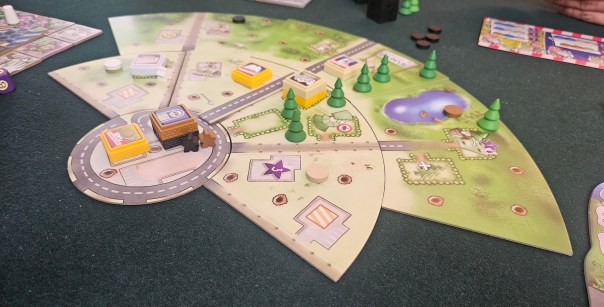
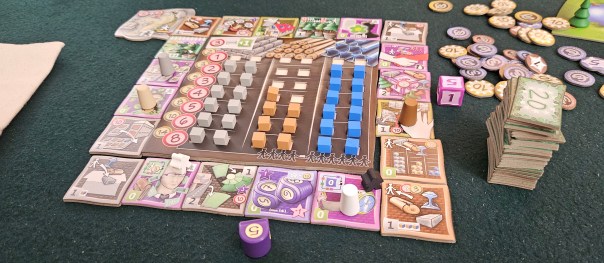
Grin Evil? Grin Good! Stop whatever you’re doing. Just stop. I need to tell you about one of the weirdest, wildest, and most interesting board games I’ve played all year. Scratch that. Ever. That’s right. Ever. This is Grinivil. It was designed, illustrated, and published by Rudy Priecinsky. It’s tempting to lob a jab in there — ā€œI can tell!ā€ hardy har — especially once you get a look at the scattershot rulebook, the potato-headed character portraits, the mishmashed card layouts, the box itself… okay, as soon as you get a look at pretty much anything it has to offer. But don’t make the easy joke. Set that aside. Because Grinivil is a gift from a parallel universe where Eurogames are never wrung dry through market testing and impersonal development, but instead allowed to blossom into bespoke artifacts that are equally uncanny and compelling and inventive. This is Grinivil. It’s breathtaking. In its early stages, Grinivil is mostly empty lots. When Grinivil begins, Grinivil — the town the board game is named after — has been thrown open to new development. As towns go, Grinivil is small. Actually, I’m not even sure it qualifies as small. The municipality has started construction on a few things, drawn at random, but they’re as yet unfinished. There are plots for houses and additional commercial spaces, but nobody has filled them. Even the trees have yet to be planted. If Grinivil were deposited in the Old West, they wouldn’t have the livestock to qualify as a one-horse town. But where there’s a vacuum, there’s opportunity. As a developer, you’re here to buy and sell land, construct amenities, and finagle clients into houses. It’s a normal enough pitch, in other words. Maybe even an unexciting pitch. There are plenty of board games about real estate, and Grinivil doesn’t sound all that far off from titles like Rebuilding Chicago, The Estates, or Magnate: The First City. Tough competition. Solid games. Good bones. But it takes Grinivil all of ten seconds to set itself apart as those titles’ spiritual opposite. For one thing, there’s the way the game looks. And I promise I’m not about to ding it. Quite the opposite. Grinivil’s earliest state, when it’s nothing more than a traffic loop and a few partially-constructed buildings atop a single pizza-slice of land, is full of potential. You can see what it might become after some walls have been put up and a few trees have been planted. What’s more, those walls and trees mean something. They signify investment. When you add a floor to a building, you mark it with a piece of your color. Now that isn’t just the second story of a bowling alley or the foundation of a house. It’s your share in the bowling alley. It’s your ability to profit off the sale of the home. Those trees are bumps in property value. That road, now paved, is a sign that a new portion of the town is open for business. And it isn’t only your investments you’re interested in. It’s everybody else’s, too. The Time Action Ring is a rondel. An amazing rondel. Let’s approach it from another angle. Turns. Turns in Grinivil take place on the Time Action Ring, also called the TAR. The TAR is a rondel. Starting at the top-left, you move your pawn clockwise around the TAR, stopping at any action you want to perform. You know. It’s a rondel. It behaves like most rondels. There are a few wrinkles to this process. First and foremost, most actions, once completed, will move you forward an extra space or two. (Or three or four.) Sometimes this bypasses another action you were hoping to take. Fortunately, you can pay cold hard cash to move fewer spaces. If pouring that foundation will move you forward three spaces, therefore passing the space you were hoping to use next turn, you can pay some money to move a little less. That’s not all. Unlike some rondels, which limit movement, here you’re allowed to visit any space. You can even circle the entire TAR in a single move if you so desire. The limitation is that passing Go will not award $200. In fact, the opposite is the case. Whenever you pass the space at the top left, you pay both taxes and your workers. Taxes, now, that’s a flat rate. But workers consume a few bucks apiece. If you don’t have any workers on the table, whether constructing a building or squatting on an ability space on the TAR, that’s not the biggest deal. But if you have three workers out, it suddenly behooves you to stretch your time on the TAR as much as possible. And then there’s the real highlight: the actions themselves. Put simply, Grinivil offers some of the coolest actions I’ve seen put to a rondel. Some are fairly routine, like buying or selling resources, but others transform the state of the board in ways that are hard to describe without seeing them in action. I’m not sure the score and road track had to be this, ah, eccentric. You might, for example, add a wedge to the map. This costs some money and awards a few points. Far more importantly, it gives you ownership over that wedge. Basically, you’re speculating on land. Now whenever anybody wants to build on that land, they’ll be paying a premium for the opportunity. Or you might turn victory points into cash. Points are the game’s objective, of course, but they don’t really matter until the end. So why not turn them in for walking-around money? This isn’t the first game to feature such an option, but it’s the only one where I’ve seen players accept that devil’s bargain. Sometimes multiple times. If you’re still short, you could also collect unemployment for all the workers who aren’t currently out there collecting a wage, or host an auction and collect the proceeds, or flip all that timber and concrete for more than you spent on it. Or you could alter the rules altogether. This is mostly the domain of abilities, spots on the TAR that must be occupied by one of your workers. This uses up the worker — and you’ll have to pay them, of course — but gives you that space’s perk until you loop back around to it. To a one, these are ridiculous. There’s the Manager, who removes the need to spend extra time on the TAR. As in, that entire portion of the game is just deleted. Or there’s the Architect. She lets you use any resources when building rather than using specific materials, letting you pass off concrete monstrosities as homes or build a pet store out of nothing but cheap steel. So much for the game’s inventory management! The Banker gives you three coins per turn. Just gives them to you. The Ecologist — my group calls him Treesus — does something similar, adding periodic trees to your inventory. Surprisingly, the most foundational action, construction, is anything but perfunctory. As you might expect, construction is where you spend materials to add a floor to the map. But it’s also so much more than that, inserting players into the overgrown thicket of incentives that is Grinivil’s principal draw. More on that in a moment. It might sound like the efficacy of these actions is game-breaking, but in practice it really means that every decision carries considerable heft. On any given turn, you’re presented with a wide-open decision space between three or four tremendous opportunities. Sometimes a shortfall can be covered by having the right resources on-hand, and it isn’t unheard of for an action to become better thanks to a cash infusion. But the real cost is always paid in the opportunities you passed by on your way to something else. As Grinivil develops, it becomes a minefield of overlapping interests. Nowhere is this more evident than in the game’s residents. Grinivil, at its core, is about attracting newcomers to town. Each resident has a number of needs, some underlined in red, others more negotiable. When the game begins, you have two in-hand. There’s also a display of additional cards that can be acquired or swapped out. Here’s an example. When you first sit down to play, you could be holding Miriam and Nela. Both are worth some points, but Miriam will pay a bunch of cash if her house is on a lot with many trees, whereas Nela is willing to pay a flat rate. Okay, simple enough. So Nela is easier to place on undeveloped land, right? Sort of! Both also have some hard-coded requirements. Miriam won’t move in unless there’s a grocery store within three spaces of her new home and a bus stop somewhere in town. Nela, meanwhile, isn’t too picky about distance, but wants a pet store and a garden center. When placed, they also provide bonuses. If there’s a playground within two spaces, Miriam will award a few extra points. She’ll also pay a premium for a nearby garden center, giving her some overlap with Nela. For her part, Nela wants a library and a music venue. Deep breath: They also provide end-game bonuses. Miriam wants a hospital in town. Nela insists on a police station. Here’s the thing. Call it a double-edged sword. Like everything in Grinivil, residents pose a certain hurdle. Their cards are, charitably, a mess of information. Less charitably, they’re just a mess. But that mess, apart from being somewhat hard to untangle visually, is important, because it’s how everything gets evaluated. When you house a resident, each of those boxes tells you something different. The top box is how many points and coins they give you right away. But everything underneath that, all three boxes of potential rewards, are awarded to whomever owns the thing in question. If I built the garden center for Nela, and then you later welcome Miriam to town, I get the cash for her proximity to the garden center even though you played the card. If I own two of the hospital’s three floors, then two-thirds of Miriam’s fifteen end-game points are mine, even if I never so much as glanced at her until the final tally. This makes Grinivil a stern plaything indeed, but it’s always fair in its unfairness. There’s hidden information, but not so much that it can’t be overcome with watchfulness and shrewd investments. There are few guardrails, but open-ended actions and a few dashes of chance make it possible to wrestle out of tight spots. I love everything about this. Which isn’t to say that these rough edges can’t prove frustrating, especially during the first play or two. Once, a player’s early investment in a water treatment plant — and we’re talking about their third or fourth action, maybe fifteen minutes into a two-hour session — translated into a game-winning swing when a half-dozen residents all insisted that their town have potable water. The beauty of Grinivil, though, is that this was entirely our fault. The table’s fault, I mean. Mine. My co-players’. Because as soon as that rival invested so much in clean water, we should have shifted our priorities. No more residents who care weirdly a lot about their drinking water being certified amoeba-free! Only cop-loving residents, or residents who insist on accessible hospitals, or residents who hang out at churches and retirement communities. Or, perhaps, we could have ensured that our game-ending tally was dwarfed by residents whose earlier payouts were sufficient to overcome any final swings. There are many ways to earn points in Grinivil, and just about as many ways to invest one’s attention and money. In all cases, though, this is a game that benefits from both experience and table-talk. It’s a game where it’s not only not impolite, but necessary to say, ā€œHey, let’s stop attracting so many residents who love the aroma of water being treated.ā€ In that sense, Grinivil is a game about cutting through the clutter to see what’s really important. (And boy howdy is there clutter, hardy har!) It’s about reading the state of the table, about observing which properties are likely to pay off big and which might only be worth a little bit here and there. It’s about watching your opponents and knowing when to feed the animals and when to hold back. Sometimes, it’s even about snaking somebody’s investment by paying a pittance to slap a roof atop their house and hustle one of your residents inside before they can protest. As more people move in, costs go up. Sorry. Them’s the rules. I like a polished game. But we’ve reached the point where too many games are polished. Some are so polished, I’d say, so devoid of rough edges, that there’s nothing left to snag one’s attention. Grinivil is the other thing. Snaggy and shaggy. Some of its actions don’t have immediate utility; others are so potent that it’s impossible to choose between them. Sometimes a corner feels too painted-in. Its art is, um, undeniably not crafted by a plagiarism engine. Personally, I like how it looks. Not only the town, which is gorgeous, but the wackadoo resident cards. Just look at those nerds. I love them like my own ex-girlfriends. For all of that — or more likely because of it — Grinivil is captivating. As in, it captures and holds one’s attention the way no number of over-smoothed experiences possibly could. It grabs your elbow, shows you the dance floor, and asks you to move. Then it probably shouts at you a little bit, before apologizing and rumpling your shirt and tucking a buck into your back pocket. No matter. This artifact, this singular vision, this gift from another dimension, is so spellbinding that it reminds me why I started playing board games in the first place. A complimentary copy of Grinivil was provided by the designer and publisher. (If what I’m doing at Space-Biff! is valuable to you in some way, please consider dropping by my Patreon campaign or Ko-fi. Right now, my third-quarter newsletter is open to all.) https://spacebiff.com/2026/10/28/grinivil/ #good #rudypriecinsky #oldwest #rss #feeds #linksharing #qwibbit
#good #rudypriecinsky #oldwest #rss #feeds
Dan Thurot (Unofficial)
Dan Thurot (Unofficial) 6d

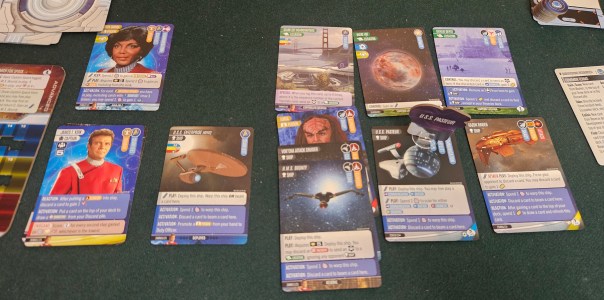
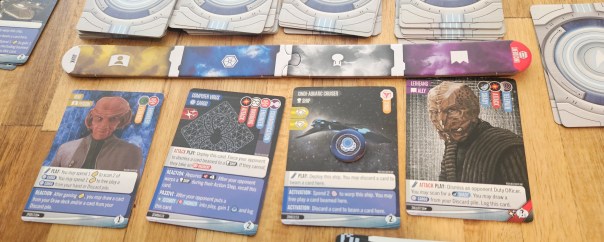
To Boldly Shuffle Ah, Captain’s Chair. I’ve already logged my appreciation of Nigel Buckle and DĆ”vid Turczi’s remapping of Imperium into the Star Trek universe. Like that series, now sadly defunct thanks to the shuttering of the board-gaming side of Osprey Games, this is an information-dense deck-builder that absolutely revels in its moreishness. Quite literally. It features more icons, more decks, and more chrome-laden rules per cubic micron than any other deck-builder I can recall. Now there’s a second-wave box, To Boldly Go. If you’ve played the original, you know what to expect. Seriously, newcomers can just read my previous review. Kirk out here Kirking. I really wasn’t bluffing. I’m not about to spill anything new. OR AM I? Look at me, playing like Q. For the most part, To Boldly Go repeats the accomplishments of that original set, featuring six new captains who can either be commanded in one of the game’s default duels or faced as an opponent in the (excellent) solitaire mode. As with Imperium, these decks are what make Captain’s Chair Captain’s Chair. Like an unassimilated technological and biological lifeform, they’re distinct. How distinct? Distinct enough that there’s good news and bad news. First, the good. The captains in To Boldly Go are even more dissimilar than those in the base box. Even the ones that are relatively ā€œbaseline,ā€ like Soval, Philippa Georgiou, and the long-awaited James T. Kirk feel different on the table. Having served as an ambassador to Earth, Soval fuels his abilities by dismissing them as a species — in game terms, by literally chucking them out of his hand. Which is a bit of a double-edged ability, since he wants to fill his deck with enough exemplars of mankind to keep his better abilities churning. Kirk, meanwhile, is an all-rounder, forced to emphasize the game’s various flavors of influence equally. The flipside is that, as the grandfather of this galaxy, he’s more likely to draw encounters, the ultra-powerful scoring cards that most captains only see one or two of throughout an entire session. The other captains are wackier, and I mean that entirely as a positive. Khan breaks the game’s usual rules, dispensing with the customary science/diplomacy/military track to instead mind-control a diverse crew and start shouting Moby Dick quotes at his enemies. No, really. He has Moby Dick quotes. Archer, being the flashback character, starts with a deck that fits in his starting hand and nearly no away team tokens for conquering planets. Instead, he has to rush to form the Federation from scratch, giving him some incredible early-game momentum but the testiness of having to forge synergies from first principles. And then there’s Rebner. I haven’t seen a single episode of Below Decks, so I have to trust Buckle and Turczi when they inform me that Rebner’s whole deal is that he’s a total moron. He draws only three cards per turn, can’t utilize science or diplomacy at all, and his cards get stronger as they find and don big hats. Aha, a card market! Actually, Rebner has become my object lesson for To Boldly Go at large. He’s a total hoot to play, and moreover he’s forced me to embrace a portion of the game I’ve always tended to overlook. Returnees to Captain’s Chair might already know what I’m talking about. In the market, there are four main decks that players can freely recruit from. Three of those decks — people, ships, and allies — offer immediate utility. The fourth, the one called ā€œcargo,ā€ has always been a little trickier to use. These are special items that… well, they do all sorts of things. Which is both the value and the drawback of cargo. You’re never quite sure what you’re going to get. Most function as attachments, things you can merge with other cards to bestow new abilities. But they aren’t always that, and sometimes their wilder effects can be more trouble than they’re worth. Rebner, with his crew’s emphasis on securing and wearing fancy hats, makes cargo a necessity. His starting deck has a bunch of hats, both in its starting pool and for later recruitment, a stark contrast with most captains who might have one or two tucked into their reserve. What’s more, a couple of additional hats can be found in the cargo market deck. They get a ā€œhelmetā€ tag and everything. But that reveals an issue with To Boldly Go. More specifically, an issue with merging To Boldly Go with the original Captain’s Chair and any forthcoming sets. In short, the original game didn’t contain any helmets. Which means that poor stupid Rebner is going to have a heck of a time finding any hats for his crew when using the original Captain’s Chair market, whether on its own or blended with the offerings from To Boldly Go. Of course, the issue is broader than a shortage of hats. It’s that each captain has their own objectives to pursue, and these objectives often require them to dive through the market for specific keywords. Some of these tags are standardized across sets. Roughly half the card pool has been duplicated from the original box, and there are always plenty of humans, Vulcans, and Klingons. For captains who need specialized tags, merging or crossing-over sets just became a testy proposition. As before, the icons are nice and crisp, but also… there are tons of them. This isn’t to say the issue is a dealbreaker. Nor that it presents an intractable problem. There have always been tools for rifling through the decks of Captain’s Chair, in particular the ā€œscanā€ ability that allows players to search through a certain number of cards — even multiple market decks — to mine a specific keyword. It’s pretty rare that you’re beholden solely to whichever cards are currently on display. But it highlights a certain jankiness to the system. Turczi has compared sets to drafting cubes. Captains function best with the cards in their box, not necessarily when merged across sets. Which, to some degree, makes the whole thing a little less appealing, at least to this guy. I’d much rather rest assured that I could have Kirk face down Koloth or Picard take on some theoretical third-wave Borg Queen without worrying about the composition of the market introducing its own subspace turbulence. Because, yeah, Captain’s Chair is good enough, even with these bumps, that I want to keep exploring what it has to offer. Even at its most maximal — frankly, thanks to that quantity-is-quality — there’s a thrill to seeing how Buckle and Turczi can mine their deck-building system for new ways to express this particular setting. I loved the diversity of cultures in Imperium, that it was possible to have something sprawling like the Roman Empire throw down with the Olmec and the Inuit, each with their own cultural focuses, and still function at all, let alone present such a compelling contest. Here, decks are even more distinct. Combined with the additional flexibility of a system that stretches further than its predecessor, the result is a game that keeps me coming back. Even when, on occasion, it frustrates me with its avalanche of icons, a lane-battler core that sometimes gets lost amid everything else, and now the persnicketiness of sets that don’t effortlessly merge. Captain’s Chair is also a lane-battler. Sorta. Maybe this was always inevitable. As Imperium grew, that system faced similar aches and readjustments. Any growing pains are only compounded by the sheer enormity of what’s contained in each box. So much for balance; then again, it was always a remote possibility with decks as varied as these. Either way, here’s to another Captain’s Chair. Going forward, I think I’ll boldly shuffle everything together, consequences be damned. A complimentary copy of Star Trek: Captain’s Chair: To Boldly Go was provided by the publisher. (If what I’m doing at Space-Biff! is valuable to you in some way, please consider dropping by my Patreon campaign or Ko-fi. Right now, my third-quarter newsletter is open to all.) https://spacebiff.com/2026/10/27/star-trek-captains-chair-2/ #chair #mobydick #startrek #like #chaircaptain #nigelbuckle #davidturczi #decks #kirk #imperium #rss #feeds #linksharing #qwibbit

#chair #mobydick #startrek #like #chaircaptain
Dan Thurot (Unofficial)
Dan Thurot (Unofficial) 7d

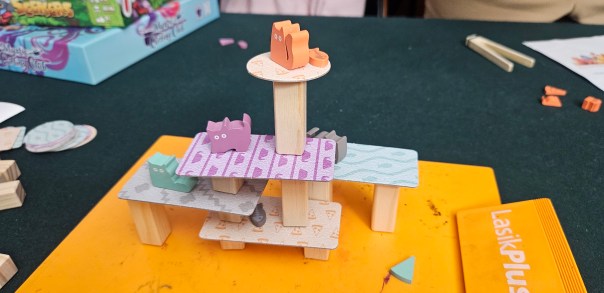
Things Had It Coming When she isn’t pretending to be a dragon, my seven-year-old pretends to be a cat. ā€œMrrrowrrr,ā€ she says when she pounces on me in bed in the morning. ā€œRaawwwrrr,ā€ she purrs when it’s time for her to line up for second grade. ā€œGrrrrrr,ā€ she rumbles at bedtime, her bones suddenly transforming to jelly. If certain ā€œnewsā€ articles were to be believed, we’d have a litter box in the bathroom. So, as a surprise, I picked up Cats Knocking Things Off Ledges. Designed by Sen-Foong Lim and David Killing, it’s as descriptive a game as they come. My seven-year-old treats it as a tornado simulator. These cats love to climb. On the surface, Cats Knocking Things Off Ledges isn’t meant to be a tornado simulator. Instead, it plays like a parallel version to Rhino Hero. Turns consist of three steps. First you expand your kitties’ playspace, adding one or two pillars and a single card, whether rectangular or circular, to create a new climbing platform. Second, your kitty leaps to a new space, managed by a pair of tweezers. Third, your kitty bats a toy from their perch. If it happens to land on another platform, you score points. The greater the fall, the more the score. It’s adorable. And not in any pejorative sense. The tweezers, for example, have little kitten paws on the inside edges. The toys are wooden versions of squeaky mice and pizza slices. The platforms show fuzzy carpet for kitties to test their claws against, but it’s really their reverse side, which reveals fabric stapled to wooden bases, that feels like something you might actually stack into a climbing tree. That adorableness extends to the rules. They’re simple, which suits the game’s format and age target. But more importantly, they capture feline caprice. Cats, according to this game, are agents of mischief. Why do they knock things off ledges? One expects the things had it coming. If the things didn’t have it coming, the cats wouldn’t have batted them from their ledges. Simple. Circular. Incontestable. Which does make it a shame that the components are so darn light. I think back on the original Rhino Hero, before its blown-up version or Rhino Hero Super Battle made it easier to handle, or that popsicle-stick stacking simulator Tokyo Highway that collapsed as though the slightest hand tremor was a seismic event. For little fingers to make a stacking game work — and seven isn’t especially little — the components need a certain heft. Aw. Sure, the box rates the game for ages 10+. Fair enough. But let’s be real: those are there to cover the publisher’s backside if a kid chokes on a meeple. No matter the specific digit on the box, Cats Knocking Things Off Ledges is what a seven-year-old who wants to be a kitten and only breaks character to insist she wants chicken nuggets for dinner wants to play. Who else would it be for? It isn’t for my twelve-year-old. She regards it coolly. She doesn’t complain. She’ll humor her younger sister. But this isn’t the sort of thing she’ll directly seek out. Who else is there? Me? My wife? Sure, we have a fine time with it. But the one who jumped up and down at the sight of the box was three years below the stated age limit. In practice, then, Cats Knocking Things Off Ledges becomes a tornado simulator. The platforms in particular are so light that their surface warps ever so slightly, closer to cardstock than proper cardboard. Not even that heavy of cardstock either. Without proper architectural planning — and, again, let’s be real here — it isn’t long before the tower teeters and shudders. At times, that’s part of the fun. Look at our tower, barely held together with thumbtacks! But when the tower keeps collapsing, especially when it collapses from even slight errors, and doubly especially when it always collapses on the youngest kiddo’s turn, well… Well, it becomes a tornado simulator. Because the kiddo starts knocking things over on purpose. ā€œMrrrowwwrrr,ā€ she says, jabbing a pillar with the kitten-stick. Everything tumbles. Which is fine, as these things go. I’m not about to insist she play the cats-making-a-mess game properly. But it puts the game in a strange place. She adores it. But her adoration has been tempered by the fragility of this plaything. It’s so delicate that she can’t help but break it, and so the breaking has become the game. For the rest of us, Cats Knocking Things Off Ledges becomes a game about rebuilding a similar edifice over and over again, eking out one or two points at a time, and then restarting the process. Bump! To be honest, I’m surprised. Lim was half of the design team behind Junk Art, one of the chunkiest stacking games on the market. If only this title had received similar care. Instead, it winds up overstaying its welcome and growing repetitive within the span of a single session. Here’s the good news: my kiddo has repurposed the pieces for building a cat tower beyond the confines of the rules. Good initiative, kitten. (If what I’m doing at Space-Biff! is valuable to you in some way, please consider dropping by my Patreon campaign or Ko-fi. Right now, my third-quarter newsletter is open to all.) https://spacebiff.com/2026/10/26/cats-knocking-things-off-ledges/ #knockingthings #catsknocking #rhinohero #coming #which #davidkilling #herosuper #mrrrowrrr #rss #feeds #linksharing #qwibbit
#knockingthings #catsknocking #rhinohero #coming #which
Dan Thurot (Unofficial)
Dan Thurot (Unofficial) 11d

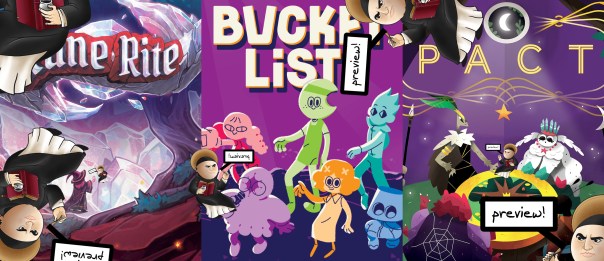
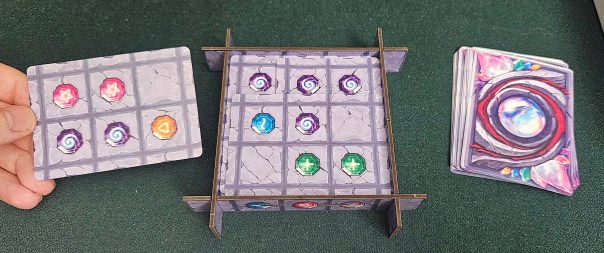
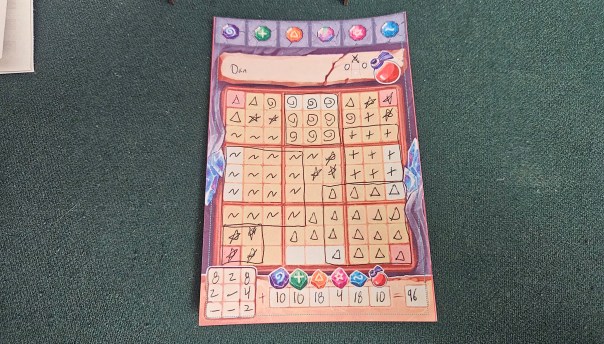
Bewitchments, Buckets, Bugs Imagine me in a real pickle sandwich. The middle of preview season (ho ho ho), and suddenly I come down with not one illness, but two. Something chronic, something acute. And me with a whole stack of board games to write about. Some of them time-sensitive, counting down the minutes on crowdfunding platforms as we speak. What’s an old man to do? Write about all three in a single splash, naturally. In other words, here are three very different tabletop titles, each worth a wink of your time. Come on in. Let me tell you about them. Briskly, before I’m back to bed. Runes, crafted, so thus they may be written. Rune Rite At a glance, Rune Rite doesn’t look all that dissimilar from any number of other flip-and-writes. Fortunately, designer Jason Katzwinkel makes one alteration that has major implications not only for this game, but for the entire format. Short version: you craft the card in advance. Longer version. Like every other instance of the genre, you begin your turn by flipping over a card. This shows some combination of runes — spirals, stars, tildes, triangles, and plusses, with the occasional wild that counts as anything and everything. Then everybody at the table gets to mark a cluster of those symbols onto a personal paper grid. The larger the cluster — say, a polyomino L of stars — the more you mark, all the way down to a single symbol. The wrinkle is that drawing a card isn’t as simple as drawing a card. You draw the card, yes, right, you’re following I’m sure, but then you choose how to lay that card over the top of any previous cards, all framed within a cardboard holder to establish the selection’s outer boundaries. In more mathematical terms, every card offers a 2Ɨ3 selection, but you’re really drawing from a 3Ɨ3 grid. So the current card matters, but so do any previous cards that might still be peeking out from previous turns. The implications are far-reaching. At the first and most obvious level, you’re given some control over which symbols — and furthermore, which shapes of symbols — you’re allowed to draw on your pad. By rotating your card, it’s possible to arrive at unusual shapes indeed. Looks suspiciously like a flip-and-write to me. But more than that, with some attention you can also sabotage everybody else at the table. Whatever shape the card-puller draws, nobody else is allowed to use. Sometimes this only provides access to smaller leftovers, but there’s room for devious plays. Such as noting that a rival wants a size-two combination of spirals, so instead you hand them a huge cluster of spirals instead. Go for it, bud. Overcommit. In some ways, Rune Rite feels like a proof of concept. It’s a small game, I mean, with very little variance between sessions apart from the actual shape-crafting that occurs on each and every turn. Unlike something like Cartographers, which changes its victory conditions between sessions, the goal is always the same. But for a proof of concept, there’s a lot to like here. There’s real tension between specialization and diversification. Points principally come from drawing boxes of similar symbols and filling other boxes with as many different symbols as possible, encouraging you to build across the pad’s boundaries. Which is to say, there’s a definite ā€œbest approachā€ here, but it isn’t one easily or flippantly pursued. I’d like to see more of this. Crafting the ā€œflipā€ of the flip-and-write is a stroke of brilliance, and here it’s given perhaps its purest possible expression. The result is little more than a snack, but it’s a snack that might prove transformative if everybody catches the vision. Like a Triscuit. Rune Rite is on Kickstarter for nine more days. Some of the things I wish I’d done. Bucket List According to internet lore, the term ā€œbucket listā€ was coined by the 2007 comedy film The Bucket List. This is a myth. My proof is a journal entry dated 14 March 2006 which reads: ā€œBucket List. Item #1. Prove that I, Dan Thurot, came up with the term ā€˜bucket list,’ not that stupid movie coming out next year.ā€ Many of the action items in Micah Heiselt’s Bucket List represent similar uphill battles. Spend a night in Dracula’s Castle? Sure, but bring the gauze. Buy a farm for orphaned alpacas? Nothing was ever stopping you but the fear of success. Fill the Louvre with only your art? Kid. Come on. You can’t even finish one board game preview on a site without the slightest quality control. Then again, that’s much of the charm of this one. You and your friends wrote a bucket list in high school. (Presumably you graduated after 2007.) Now, with death swiftly approaching, you must tick off as many boxes as possible. What would otherwise be a cutesy gimmick game is elevated by two factors. The first is that the gameplay is a combination of long-term planning, thinking on your toes, and careful risk management. There are only two main resources, time and money, which must be invested into a goal before it can be accomplished. That’s simple enough, but resources come from multiple sources, some more reliable than others, such as action cards versus a turn-initiating roll of the dice. You’ll get something, but whether you can put it to good use is another question. Oh, and any leftovers will anger the Grim Reaper. Death comes for us all. The Grim Reaper is the other shakeup to the formula. Various triggers will see old boney chasing everyone around the score track. If he catches up to the trailing player, a headstone will be placed to end the game upon the completion of the round. There are ways to cheat death, nudging the Grim Reaper back on the track and returning the headstone to its resting place… except you might not want to delay the end of the game if you’re sitting pretty at the top of the score track, leading to little tussles to delay or hasten your mortality. It’s a bit grim. But then, so is anything associated with bucket lists. The good news is that it’s also an amusing little plaything, with more to consider than first meets the eye, and lots of goofball moments where death seems around the corner only to be delayed yet again. It’s ultimately a game about picking your battles. There isn’t time or money enough to do everything, so you’re encouraged to pad out your days with goals that can absorb whatever resources happen to come your way. In that sense, there’s something comforting about it, almost nihilistic in its dedication to self-determination. Maybe it will even inspire me to fulfill the other entries in my bucket list. ā€œItem #2. Change it back to Berenstein Bears before anyone notices.ā€ Bucket List is on Kickstarter for fifteen more days. This tree is especially bug-infested. Pact Pact is what you get when you blend the asymmetry of Root with the hard tradeoffs of a classic card-driven wargame like Twilight Struggle. First, the Root. Four bug factions occupy the tree kingdom of Branchbourne, each with its own advantages. There’s Jenna Ermine VI, her authority thoroughly entrenched across the branches and boughs of the kingdom, but spread so thin that the slightest tension might crack her carapace. Her closest rival is the Duchesse Orich, incredibly well resourced but also over-leveraged. Somewhat farther underfoot is the revolutionary Matuk Inkclaw, capable of unleashing labor strikes that cripple the kingdom, and the heretic Weaver Neith. Mostly I remember Weaver Neith mind-controlling everybody. All right, asymmetry is hot right now. But the second half of the game, the card-driven wargame half, controls how things get done. Everything relies on event cards. At any given time, a handful of these are on offer in the market. Taking a turn isn’t as simple as moving pieces. Instead, you select an event. If it’s your own, you either use the card for its action points — adding tokens, moving stuff between locales, that sort of thing — or take its historical outcome, which is always weirder and often more potent, but less directed. On the other hand, if it belongs to someone else, you take the actions while they trigger the event. Pretty normal, as card-driven wargames go, but rather novel when it comes to bug-based fantasy games. Events are the heart of Pact. Making matters more complicated, society in Branchbourne is dominated by four ā€œpillars,ā€ each of which demands some measure of attention lest the kingdom fall into disrepair. These are handled by moving treasures, a nearly zero-sum economy, between their four domains. The Merchants, for instance, are how cash gets infused into the economy. By investing treasures into their domain, additional treasures wink into existence ex nihilo. Invest too much, however, and the Merchants will crash the whole dang thing, reducing the number of treasures in circulation. Okay, so you want the Merchants to have a lot of treasures, but not so many that they wreck the economy. Except the other pillars also have their own requirements. The Nobility mostly function as parasites, destroying treasures outright, but if not placated they’ll steal treasures from the other pillars. The Church is similar; they like to gather treasures as tithes, but they can manipulate the standings of the other pillars outright. The Military, meanwhile, needs treasure. Lots of treasure. Only their threat is no paper tiger-beetle; if they don’t have enough loot in their vault when the round ends, the centipedes chewing at Branchbourne’s roots will overrun the kingdom and eat everybody. This prompts a delicate balancing act. Your faction doesn’t only want to survive; they also make pacts (the title! oh ho!) with those pillars to see them succeed in exchange for influence at court. So, depending on how you’ve positioned your faction, you might want the bank to fail this round, since its collapse will humiliate your rival who’s aligned with them, while feeding heaps of glittery to the Church in exchange for their imprimatur on your ascending the throne. Keep forty eye-facets on those centipedes. Which brings us full circle to that event system, because this is where you can manipulate every little corner of Branchbourne to your advantage. The Duchesse Orich, for example, can use her hives to bestow additional treasures on various pillars of society. But when an event raises the opportunity to do so, will it align with her current goals? The same goes for the firebrand and his labor strikes, the Empress and her loyalty counters, and everything else. Pact is a game of hard tradeoffs. Direct action or powerful but perhaps misaligned events? That’s the question, baby. All told, the result is a fable about the ever-shifting halls of power that I find mighty intriguing. Like a lot of the best games, designer Zach Hoekstra has keyed into the fact that smart design is often about limitation as much as it is about player agency. Often, turns force a choice between which goals you’ll fail at the least. It’s a lot like tacking into the wind; moving at increments that seem to go nowhere, only that bit by bit move you closer to your objective. The result is one heady political game indeed. Of the titles on this list, Pact is the heftiest, but it’s also the one I’m most eager to see reach completion. It’s ambitious, it’s weird, it’s full of bugs. Pact is on Gamefound for nineteen more days. Prototype copies of Rune Rite, Bucket List, and Pact: The Future of Branchbourne were temporarily provided by their designers and publishers. (If what I’m doing at Space-Biff! is valuable to you in some way, please consider dropping by my Patreon campaign or Ko-fi. Right now, my third-quarter newsletter is open to all.) https://spacebiff.com/2026/10/22/rune-rite-bucket-list-pact/ #rss #feeds #linksharing #qwibbit
#1 #2 #rss #feeds #linksharing
Dan Thurot (Unofficial)
Dan Thurot (Unofficial) 18d

A Place for All My Fussy Guests It’s almost too obvious to state aloud, but there’s a lot to be said for the games we actually play. Case in point, Enchanted Ivy, the solitaire game by Sarah Joshua. When I sat down this morning to begin writing this review, I went through the usual steps. Picking and editing the images. Uploading the template and arranging everything into logical order. Glancing through a few notes. But then I thought to myself, maybe I don’t understand this game yet. Even though I’ve played it well over thirty times. One more session. In endless mode with randomized guests. Just one extra play to make sure I know what I’m talking about. And then, with such inevitability that I’m not sure why I ever thought differently, I played it twice. That’s Enchanted Ivy for you. Some of these guests are fighting. Perfect for playing my mandolin! Enchanted Ivy is about building an inn. It’s a magical inn, always shifting, and covered with ivy and blossoms. The arrangement of that ivy is the first layer of the game’s challenge. The more interconnected the ivy — the fewer gaps in its protective foliage — the more points you score. But Enchanted Ivy isn’t only about the structure. It’s also about the guests who will inhabit it. Every card can be flipped over. One side shows the ivy growing along the plaster and brickwork. The other shows the same, but with the addition of a balcony. These are the spaces for your guests to inhabit. Turns are simple. You draw two cards and two guests. Both cards will be placed: one on its bare side, the other for its balcony. Onto the balcony you’ll place a single guest. Then you draw back to two cards and two guests. Simple. Picking which fussy goofball to welcome into the inn. Except the only simple thing about Enchanted Ivy is its turn structure. Your guests are the real challenge. To a one, they’re fussy. Fussy and wonderful. And since most sessions require you to balance the needs of ten or so guests, whether you’re tackling one of the game’s ten scenarios or tinkering with the randomized endless mode, their needs clash almost immediately. For example, today I was faced with some tough conflicting imperatives. Some of my guests were all about proximity. Such as the Dog, who wants to keep his three heads affixed to as many guests as possible, and the Gift Giver, a Santa knockoff who can only be bothered to walk in two straight lines through the inn, but scores quite a few points for every room he leaves a present at. Others, though, wanted room to spread out. Like the Adventurer with his grappling hook, ready to swing across gaps to say hello, or the Washer, needing another window somewhere across the way to suspend her clothesline from — the farther all the better for hanging additional wet underthings — or the Firebreather, determined to regurgitate flames against empty diagonals. At times, the sheer bulk of these needs — having to house an Astrologer who wants an unobstructed view of the night sky next to a Cat that intends to wander from sill to sill — can seem overwhelming. Especially when you first reveal all those guests. Ten! Ten! How am I going to keep ten people straight? Each guest has their own scoring objective. To its credit, this is where Enchanted Ivy really shines. The scenarios, which present a lovely little tale about coming to accept one’s changing identity (I smell a metaphor!) introduces guests steadily but not so quickly that they become overwhelming. And really, the whole thing is brief enough that it usually demands a second session to see how many extra points can be wrung from a set now that you know your guests’ peccadilloes. Very quickly, I developed favorites. The Fighters, paired guests who must be kept apart at all costs. The Raven Keeper, observing the comings and goings from above. The Architect and his invisible lines across the way. Of course, there were also those guests for whom my welcoming smile was more of a rictus. The Fool and his juggling. The Mystery Knight insisting that his bath demands privacy. The Justice’s demand for absolute symmetry of guest placements. That hag. No matter the combination, though, there’s a fairness to the process. Sure, it’s possible for a bad draw to smash your plans. I’m speaking in a more holistic sense. Before Enchanted Ivy jumbles the pieces together, it shows you the parameters. The guests who must be housed. The shape your inn will take today. Who’s going to be a problem. If you’re playing a scenario, which optional challenges you can tackle. And then you take those pieces and make something beautiful. I always take a moment to look over my completed inn. Lots of board games are about making something beautiful, whether visually or mathematically. Enchanted Ivy lets you do both. But more than that, it asks you to linger. To spend an extra minute. To observe the flaws in your creation and appreciate them. Which is to say that even after all those sessions, even after learning how to manage the game’s thirty-odd guests, after checking off every scoring goal and special objective in the campaign, I keep coming back for one more visit. This is one of the finest solitaire games I’ve played in… well, in ever. A complimentary copy of Enchanted Ivy was provided by the publisher. (If what I’m doing at Space-Biff! is valuable to you in some way, please consider dropping by my Patreon campaign or Ko-fi. Right now, my third-quarter newsletter is open to all.) https://spacebiff.com/2026/10/09/enchanted-ivy/

Dan Thurot (Unofficial)
Dan Thurot (Unofficial) 18d

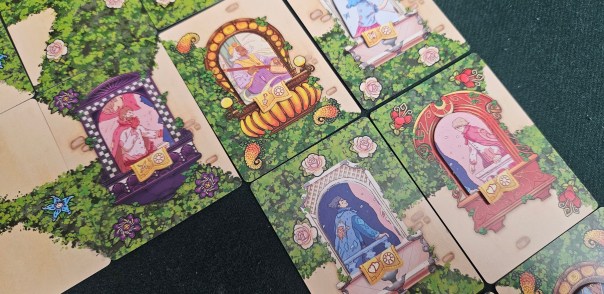
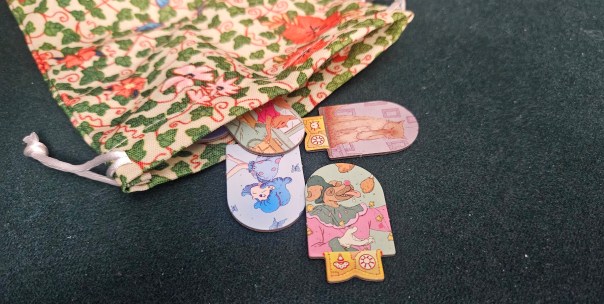
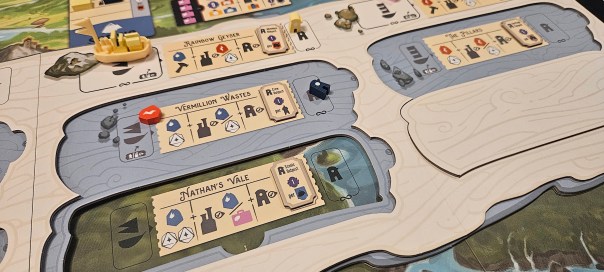
Cumulostratic Cruise On not-so-rare occasions, I get to play board games before they’re fully polished. There’s something about seeing a game struggle through its growing pains, watching its knobbly limbs grow lithe and athletic, its protrusions smooth and frictionless, that recalls editing a novel for publication or appraising frames for the final cut. Most of the time, this process is a hard one. ā€œMurder your darlings,ā€ Sir Arthur Quiller-Couch said of an author’s finest phrases. Cut them down to size. That’s what it takes to make something great. Only I’m not convinced we don’t sometimes murder a little too liberally. Sometimes I’ll play a finished game only to discover that the essential soul that made its earlier incarnation worth experiencing has been killed along with the wobbly iconography and degenerative action states. Somewhere in the process, development has sanded down the knobs and protrusions — and left little more than a burnished stick. Good for a walk, perhaps, but not especially notable. Which brings us to Braided Skies, created by Dan Germain and Stonemaier Games. When I say a game has ā€œtopography,ā€ I don’t usually mean it literally. Ever played a board game about operating a tour company that whisks hard-earned customers to exotic locales aboard custom pleasure craft? That’s Braided Skies. Or, well, Braided Skies is the other one. The one that isn’t Galactic Cruise. It’s a gentle game. Strait-laced. Customary. Literally. In an era when worker placement has the air of either a past fad or something that complements other systems rather than standing on its own, Braided Skies puts the concept front and center. Turns consist of taking an airship, of which you own three, and sending it to a destination. Most of the time, these placements are completed without restriction. Only on occasion do you need to pay attention to the vessel’s little flags, whether one, two, or three, to determine whether it can safely navigate to a particular port. There are variables on the formula, as you might expect. The mainstay is the game’s approach to topography. When Braided Skies opens, a thick cloud layer covers most of the board. Technically it’s two layers of additional cardboard, buckled against one another with the help of hidden magnets, but you get the gist. These layers conceal additional ports that are only gradually uncovered as you visit the spots on top of them. The clouds part to reveal some bonus — an extra card, one of the multi-colored ā€œtapstonesā€ that function as airship fuel, maybe a few seeded points at a location to incentivize a visit — and then, underneath, a new location brimming with resources to exploit. Adding workers to my workers. Similarly, ships and ports alike exist to be upgraded. Since they function as your workers, the former are the real highlight, permitting both a sailor and a little factory to come along for the ride. (A little loosely, it must be said. It would have been preferable for them to snap into place rather than wobbling over the side at the slightest nudge. Crewing an airship is no joke.) These upgrades goose the value of the ports you visit. Similarly, many ports can be staffed with outposts for another helping. Which is all to say, where your early airships feel a little underwhelming, it isn’t long before you’re fielding — floating? — absolute resource-guzzlers. Every time you descend into port, your hold swells with tapstones and tourists. This in turn initiates a little… I wouldn’t call it a minigame. It’s far too light for that. But a mini-minigame, one where your newfound cargo must be loaded into the proper slots or get left behind. It’s always free to load cargo into the ship that did the hauling, provided there’s room. Loading stuff onto other ships costs grit, a more abstract resource, and might be worthwhile if you’ve added the right outfitting cards to a ship. Look, this is all a mouthful, but in practice it’s silky smooth. Ships go out and pick up resources. Resources go into your ships. The more outfittings a ship has, the more it can hold. The real highlight, though, is what those outfittings do when you bring a ship back home. Recalling your ships is maybe the best part of the game. Recall turns have long been the bane of worker-placement games, and if there’s any one thing that Stonemaier Games has set out to solve, it’s the recall turn. Germain has done as good a job as any, and likely better. The idea is that returning ships trigger all their outfittings, but only if they’re full of resources. This is how you… well, everything. Speed along the tracks that act as game timers and make your card icons more valuable in the endgame. Earn points. Gain passive trickles of resources. Add extra outposts to the map. More often than not, it’s the return trip that’s the more exciting of Braided Skies’ tidal phases. Going out, you get resources. Coming back, you put those resources to work. Naturally, resources don’t only serve that one purpose. The real spills of points are found on the map, mostly in the form of wonders. Basically, these are the destinations you’re delivering passengers to, provided you haven’t forgotten about them in your distraction with other shiny possibilities, which I’m somewhat pleased to report has happened to me on more than one occasion. This in turn produces a certain tension. Should you spend all those resources to secure access to another wonder? Or ensure your recall turn will be as stocked as possible? As generous as Braided Skies is, it isn’t uncommon to find oneself just short of having enough resources to have it both ways. Eventually you’ll have to actually take tourists to tourist places. Which isn’t the same as saying there’s any stress to these decisions. Like much of Stonemaier’s output these days, Braided Skies is as buffed of friction as possible. There’s a certain arc to the game that rarely deviates from its appointed path. Early on, everybody stocks their ships with factories and crew. Later, they onboard huge amounts of resources and churn them into points. Every so often — but not often enough to make it really matter — someone will require a specific ship to visit a particular port. But this doesn’t extend to wonders, nor to any of the actual points-scoring locales. The result is an endgame gold rush for points, one with hardly any consideration for, say, sweeping something out from under a rival. There’s no sacrifice to anything. No dangerous headwinds to navigate; no spots that sacrifice a shipboard factory for a heap of points. If anything, the board seems to develop from one side to the other. Halfway through the game, the spaces along the bottom are all but obsolete. Why visit them? You’ll never need to crew up again. The time for new outfittings has passed. Now is the time to gather and spend resources. Really what I’m trying to say is that Braided Skies is rewarding but hollow. Every move gives you something, but it isn’t often that something will be demanded in return. I have no idea if there was a more rough-and-tumble version of this game at some point. One where blocking mattered. One where a keen move could upend an opponent’s plans with purpose rather than incidentally. But I hope so. If only because Braided Skies truly is impressive, in its way, full of systems that feel good to manage and some smart ideas about how to evolve a map and make recall turns exciting. Those parts of the game deserved extra kindling. Something they could spark against. Braided Skies sure is a looker. On the whole, then, Braided Skies is a feel-good game that struggles to elicit grander emotions than the muted pleasure of adding more tokens to your stockpile, ticking along a scoring track, or ticking along a different scoring track. It’s lighter than the titles that usually get pegged as too light for ā€œseriousā€ play, the Wingspans and Wyrmspans and Finspans. If not in terms of rules — a caveat I add entirely for the sake of Wingspan Pocket — then in terms of consequence. Still, I’ve enjoyed my time soaring across this particular cloud-banked continent. Enjoyed and forgotten. But enjoyed all the same. A complimentary copy of Braided Skies was provided by the publisher. (If what I’m doing at Space-Biff! is valuable to you in some way, please consider dropping by my Patreon campaign or Ko-fi. Right now, my third-quarter newsletter is open to all.) https://spacebiff.com/2026/10/12/braided-skies/

Dan Thurot (Unofficial)
Dan Thurot (Unofficial) 18d

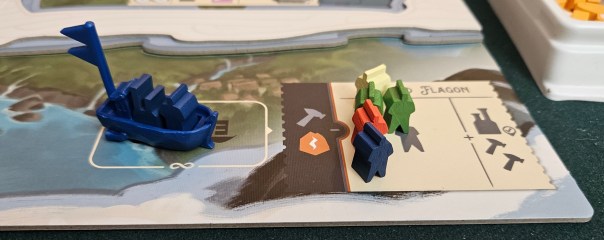
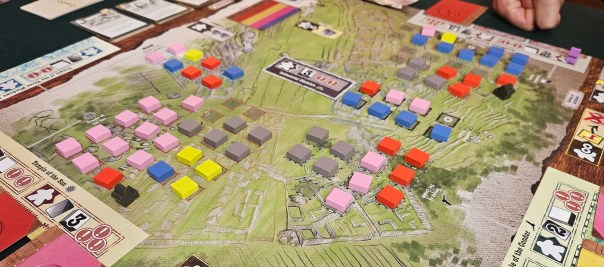
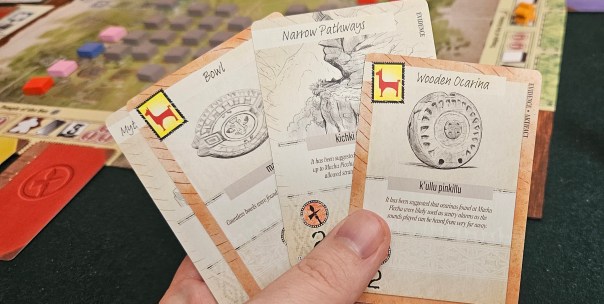
Given the Land If They Lived Righteously I’ve never been to Machu Picchu, but it was the site that demonstrated to me at an uncomfortably young age that history wasn’t just one thing but many, and that those many things were subject to a wide range of interpretations. Even, possibly, that they might end friendships. Which is appropriate, because that’s exactly what WiƱay Kawsay, designed by Alison Collins, is all about. Machu Picchu, from above. At a sky-high level, WiƱay Kawsay is set at Machu Picchu. You can see it right there. The map is even helpfully labeled with the various temples and complexes that were constructed by the Inca Empire sometime in the 15th century. But the game is also set elsewhere: in universities and magazine offices, at dig sites and museum storerooms, and in the minds and imaginations of historians, archaeologists, students, and countless readers and viewers. For such a complicated tale, not to mention one told by a freshman designer, WiƱay Kawsay is deftly told. Collins weaves an entire warehouse of threads together with real deftness. The resultant tapestry — perhaps more appropriate, the cumbi — appears simple. In reality, it’s anything but. Most board games would have their players build Machu Picchu. In WiƱay Kawsay you’re here to deconstruct it. To deconstruct and dig and brush away sediment, to catalogue, to publish, to argue. In its earlier incarnation, the game’s full title was ā€œWiƱay Kawsay: Publish or Perish,ā€ a mouthful that was nonetheless instructive. You are historians, practitioners of a 20th-century discipline rather than artisans of the 15th-century, and the mountaintop ruins have yet to yield their secrets. Evidence cards extracted from the dig site. Little by little, your search scratches the surface. Gray blocks are removed from the map along with evidence cards, their backs color-coded with hints about their nature. This portion of the game is operated via worker placement, with researcher meeples deployed to recover blocks and artifacts. As the rulebook indicates, there’s an element of destruction to this process. Stones must be removed — carefully, with intention to be replaced, but removed all the same — to uncover what lies beneath. Artifacts will be removed for study and, often, displayed in far-off countries or private collections. In game terms, this translates to ā€œimpact.ā€ For every block displaced and card recovered, you move along a track, leaving a trail of displacement in your wake. Everything recovered reveals a function. Ornate pottery speaks to wealth. Sudden abandonment hints that the site may be one of the continent’s mythical lost cities. Guardhouses and moats and narrow bridges indicate military use. The astronomical alignment of windows and dwellings prompts thoughts of the heavens. Very quickly, however, one thing becomes clear. There is no singular ā€œtruth.ā€ At least there isn’t one hidden in the deck of evidence cards. There are tendencies, certainly. In the aleatory shuffle that begins each round, sometimes a corner of Machu Picchu develops in one way or another. A cluster of pink cards speaks to the site’s religious importance; a scattering of reds lends credence to the idea that this was a military citadel. But it’s what you do with these fragments of evidence that makes WiƱay Kawsay so compelling. Academic publishing works exactly like this. First, evidence must be published. This is presented via an atypical auction system. One player approaches a publication — a journal of military history, say, or a compendium of ancient history. They arrange their evidence cards and at least one of the gray blocks they took from the dig site. This is their bid. At this point, competing players are allowed to get in on the action with their own cards and blocks. When everything is revealed, this might result in competing interpretations. In fact, it’s downright common. Icons are tallied to reveal which interpretation is most favored at the moment. Then the player who submitted the bulk of the evidence in that interpretation becomes the publication’s author, adding a color-coded book or two to the professorial desk that serves as their resource shield. In its abstraction, this auction system captures something of the discourse that is historical authorship. Ideas matter, but only in the turbulence of publication and counter-publication. Along the way, things fall through the cracks. One interpretation that seemed solid might slip out of favor, only to resurface later when its evidence card is dredged from the archives. Meanwhile, material artifacts — a broken spine, misgendered bones, grave goods — become tally marks in ideological tug-of-wars, disappear into a crate somewhere, and then are found later to be returned to Peru, usually with some gravity of ceremony to ensure your institution doesn’t get in too much trouble for pillaging somebody’s heritage. Which is to say it’s all so very earthy. This is history as tangible product, something dug out of the earth and then fiercely argued over. History, even, as personal prejudice and petty squabbles. It’s history as the ongoing conflict between fieldwork and archive work. And the game hasn’t even unveiled its centerpiece yet. The tenure track is fraught with frustrating requirements. Accurate. When the game opens, you haven’t yet established a favored interpretation. That occurs naturally as you publish your first papers. But then, maybe twenty minutes in, the game shifts gears. You have your interpretation. Now you’re asked how you’ll defend it. There are three options. The first one, the one most of us would recognize as history as an ideal practice, is Empiricism. Over time, your approach to the evidence changes. This requires you to put forward and defend multiple theories — sometimes contradictory theories. By publishing books in multiple colors, your ultimate reward is a well-rounded score derived from a whole range sources. In some ways, Empiricism is a safe bet. Any and all evidence might become valuable. But as you’ll soon discover, it’s also a precarious approach. On the opposite end of the ideological spectrum is Determinism. This approach puts forward a single theory at all costs, seeding only a single color across the map of Machu Picchu, but scoring those blocks over and over again. As a Determinist, you have the answer already in mind. The evidence is down there. All that remains is to find it. And to ignore, bury, or overwhelm any evidence to the contrary. The third route sits somewhere in the middle: the Popularizer. Rather than having an interpretation at all, the Popularizer is here to talk about how cool history is. Basically, you’re the 20th-century history version of those I Fucking Love Science social media pages that share unsourced listicles about how neutron stars prove the universe is one big brain, maaan. In some ways, this is the safest route. As soon as you declare yourself a Popularizer, you ditch the burden of having an interpretation at all. Instead, you gain a documentary crew. This you place on one of Machu Picchu’s sites, where it earns points for every colored block. Not only some, like the Empiricist. Not only one, like the Determinist. All. As your popularity expands, you unlock additional film crews to cover further sites. Maybe you’ll even talk about aliens on some podcasts. (Note: There are no aliens in WiƱay Kawsay. Thank goodness.) ā€œAccording to one article we found on the internet, the Inca preferred Easter hues.ā€ What’s so fascinating about the model Collins has presented here is that it demonstrates not only the process of uncovering and writing history, but also its dangers and drawbacks. Here’s my favorite example. In one session, I was playing as an Empiricist. That meant I favored nearly all evidence, right? Well… sorta. As the game progressed, one of my rivals outed himself as a Determinist. Specifically, a Determinist for the military theory, the idea that Machu Picchu was a citadel that projected force onto the surrounding agricultural communities. And he was doing a bang-up job of finding evidence. Red cards, the ones that support the military interpretation, were appearing all over the place. When a lull in mace-heads and splintered bones finally presented itself, our resident Determinist had already unlocked the special action that let him plunge into the archive — the discard pile, which is very much in-play throughout the entire game — to pull out cards that matched his ideological slant. The board was redder than the binding of Chairman Mao’s Quotations. Or the cover of a Dan Bullock board game. Very red indeed, is what I’m saying. Which meant that I, the Good Guy, the One Who Accepted All Evidence, started burying red blocks every chance I got. I still earned them, of course. In the course of publishing articles about The Militant Traditions Evident in the Soil Layers of Machu Picchu, I gave the military theory its due. Still, while I was oh so impartial on paper, beneath my player shield I was hoarding red blocks rather than adding them to the map. I even scoured each round’s opportunity cards for new ways to swap one color for another. A lecture series became a chance to discuss how, yes, there were some military artifacts here and there, but they really bore religious significance. Adios red blocks, hello pink blocks. I capitalized on popular beliefs to add more yellow blocks to the Temple of the Sun. I abused radiocarbon dating to swap reds for blues in the Residential District. And I won. By the slenderest possible margin, I took it. I’d become the very thing I supposedly despised, a vandal of the archaeological and written record. But I’d beaten my foe, and done so while remaining the very model of a modern history-writer. To the outside world, anyway. Opportunity cards consider the broader social sphere. I wish I could say that these abuses of history are the exception, but that hasn’t been my experience. I grew up in a culture that enthusiastically encouraged higher education for everyone… provided everyone then used that education to prove the right things. Machu Picchu was one more bystander of that culture war. In middle school, a close friend bragged to our group about how his father was taking people on tours that proved the Book of Mormon had really happened: it had been a Nephite stronghold, a satellite kingdom of Zarahemla that was wiped out in the war against the Lamanites a few hundred years after Jesus Christ had visited the Americas. In reply, I pointed out that the latest radiocarbon dating placed its origins no earlier than 1420, and furthermore argued that it was problematic to rob an indigenous group of their history to service a white Christian millenarian narrative. LOL. I didn’t say any of that. I didn’t know the first thing about the Inca, and I probably would have told you that ā€œcultural appropriationā€ was when you really liked bratwurst. But those ruins were a long way from where my seminary teacher said Zarahemla was really located, so I bounced back with something like ā€œThat’s bonkers.ā€ Eloquent seventh-grader fare. Anyway, my friend got very upset. ā€œAre you calling my dad a liar?ā€ upset. Not-talking-for-three-days upset. So upset that he stopped eating lunch with me. Because even when history is very badly done, it matters. That’s one of the things Collins seems to be saying in WiƱay Kawsay. These ruins are real. The artifacts we draw from them are real. But the stories we tell about them are only perceptions of reality. Better or worse, accurate or inaccurate, studious or half-baked, they were written by people who had their own versions of the Inca, or what certain items must have been used for, or how this story could be told. My publications. This situates WiƱay Kawsay in rare company. Plenty of games use historical settings, but not many of them are about history. WiƱay Kawsay is about history. It’s about how history is the study of primary sources and artifacts, but about how it’s also about relating a story that makes sense. The result is a warning as much as it is a love letter, a game that believes in the process of making good history — in looking at the past, the entirety of it — but which is never unaware that bad history is always close at hand, one error, oversight, or unexamined bias away. Hopefully there are correctives, found in peer review and publishing and debate. Hopefully. At any rate, Collins has crafted something impressive, a heady blend of sharp gameplay and shaper insight that’s far simpler and more playable than anyone could rightly expect. A complimentary copy of WiƱay Kawsay was provided by the publisher. (If what I’m doing at Space-Biff! is valuable to you in some way, please consider dropping by my Patreon campaign or Ko-fi. Right now, my third-quarter newsletter is open to all.) https://spacebiff.com/2026/10/13/winay-kawsay/

Welcome to Dan Thurot (Unofficial) spacestr profile!

About Me

Unofficial automated RSS/Atom links to Dan Thurot's work on Tabletop-game criticism, reviews and play reports. Original work is credited at the source; follow the source links. Zaps support the independent feed operator, not the author.

Interests

  • No interests listed.

Videos

Music

My store is coming soon!

Friends